


BBC News
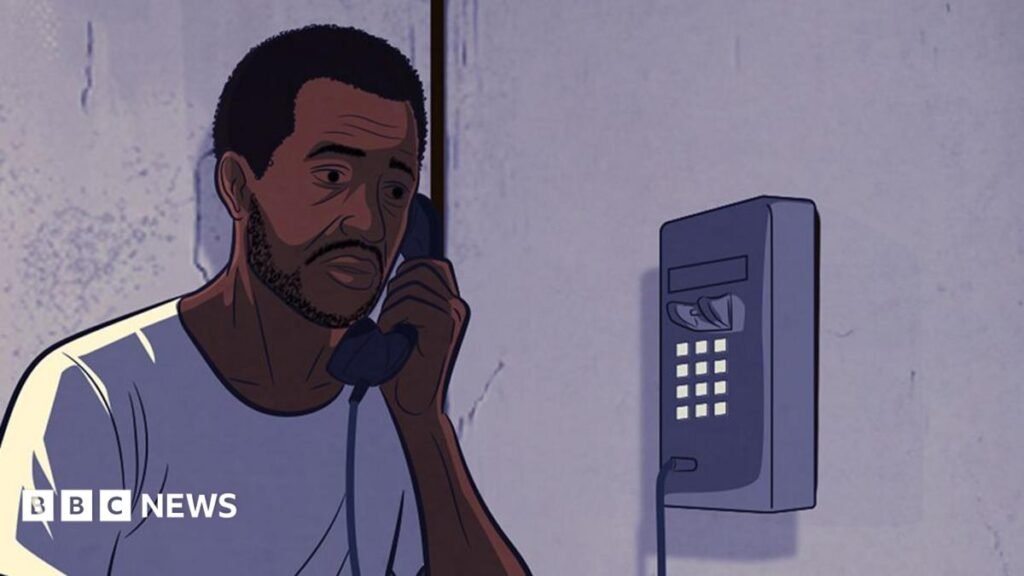
There was desperation in the voice of the young Ethiopian man when he managed to get through to the BBC from a phone in his prison cell on death row in Saudi Arabia.
Habtom, whose name – like the other prisoner featured in this article – has been changed to protect his identity, has been held in a jail in the southern city of Khamis Mushait for more than three years.
Above the noise of cellmates shouting behind him, he pleaded for help and sounded angry that his government appeared to be doing little to change his fate.
“One prisoner cannot comfort another. We have no choice but to cry. We are waiting for our turn, even though we do not know when it will happen,” said Habtom.
He and some of his fellow inmates had fled war and poverty at home in the hope of finding a better life.
But that quest, which took him through Djibouti and Yemen, led to his incarceration – joining a growing number of Ethiopians in Saudi prisons who face the prospect of execution for drug-smuggling offences.
Anxious to tell their story, some of the prisoners managed to get hold of the mobile phone number for the BBC’s Tigrinya language service. In total we have spoken to seven of the dozens – perhaps as many as 200 – Ethiopians inside the prison who are waiting for a death sentence to be carried out.
Other foreigners, including Pakistanis, Sudanese and Jordanians, are in a similar position, but in the first seven months of this year 17 Ethiopians have been executed – the highest number among non-Saudis. Five of those executions happened on Monday.
Two years ago, according to research by Amnesty International, just two Ethiopians were executed, but 35 were put to death in 2025.
It is not clear exactly why there has been an uptick, but it could be linked to more people leaving the northern Ethiopian region of Tigray, where a brutal two-year civil war in Tigray ended in late 2022, leaving devastation in its wake.
“It may also be linked to Saudi Arabia’s expanding use of the death penalty for drug-related offences in recent years,” Amnesty International researcher Dana Ahmed tells the BBC.
Habtom, who like most of the those the BBC spoke to is from Tigray, was found guilty of smuggling hashish, a type of cannabis. In Saudi Arabia, on the judge’s discretion, a guilty verdict can result in a death sentence.
But rights groups – including Reprieve, Human Rights Watch (HRW) and Amnesty International – have said that in these kinds of cases due process is rarely followed.
Defendants are not given access to a lawyer or the court papers – while translation, when it is offered, can be inadequate, Amnesty’s Ahmed says.
Although there is the theoretical right to appeal, without a lawyer they cannot submit one “and then the sentence is automatically upheld”, she says.
“There is a near-total lack of transparency throughout the entire judicial process, from sentencing to Supreme Court review and ratification by the King. People on death row and their families are left in the dark about their fate.”
Habtom alleged that he was not given the chance to speak to a lawyer or defend himself. He also said he was forced to sign a document in Arabic, which said he agreed to the sentence, without understanding what he was putting his name to.
Other prisoners that the BBC spoke to had similar stories about the legal system.
HRW has also contacted people close to the cases and learned about “mass sentences, mass trials that lacked any kind of due process and people detained then just waiting with no idea when the sentence would happen”, Nadia Hardman, the organisation’s senior adviser on refugee and migrant rights, said.
The Saudi authorities did not respond to a BBC request for comment on allegations that the legal process was not fair, but every execution is accompanied by a statement issued through the official press agency. It outlines a clear process: an investigation, a court case, an appeal, a Supreme Court ruling and then a royal decree.
The sentence reflects the commitment to protect citizens “from the scourge of drugs” and the damage they can cause, the statement adds.
Habtom said that although he manged to keep in occasional contact with his family via the wall-mounted phone in his prison cell, he refused to tell them he was on death row: “I would rather they be told after I die than now.”
He had dreamt of finishing high school, graduating from college and getting a job to support his parents – but the Tigray war put paid to that.
“My goal was destroyed, so I decided to emigrate,” he said.
After surviving the dangerous journey to Saudi Arabia in 2021, Habtom found low-paid work as a goatherder, but his employers offered him and others a chance to earn more money.
#Ethiopians #death #row #Saudi #Arabia #Prisoners #calling #BBC #cells,
Source link


