


BBC News
Mercedes’ George Russell took his first victory since June by holding off Max Verstappen to win the Azerbaijan Grand Prix.
Verstappen’s Red Bull team-mate Isack Hadjar completed the podium on his return after missing three races with a broken wrist.
Championship leader Kimi Antonelli finished fifth in Baku, meaning his advantage over team-mate Russell has narrowed to 66 points.
This weekend, Formula 1 heads to Malaysia, the host of the Bahrain Grand Prix – an event originally due to take place in April but which was postponed because of the war in the Middle East.
Before the race in Sepang, BBC F1 correspondent Andrew Benson answers your latest questions.
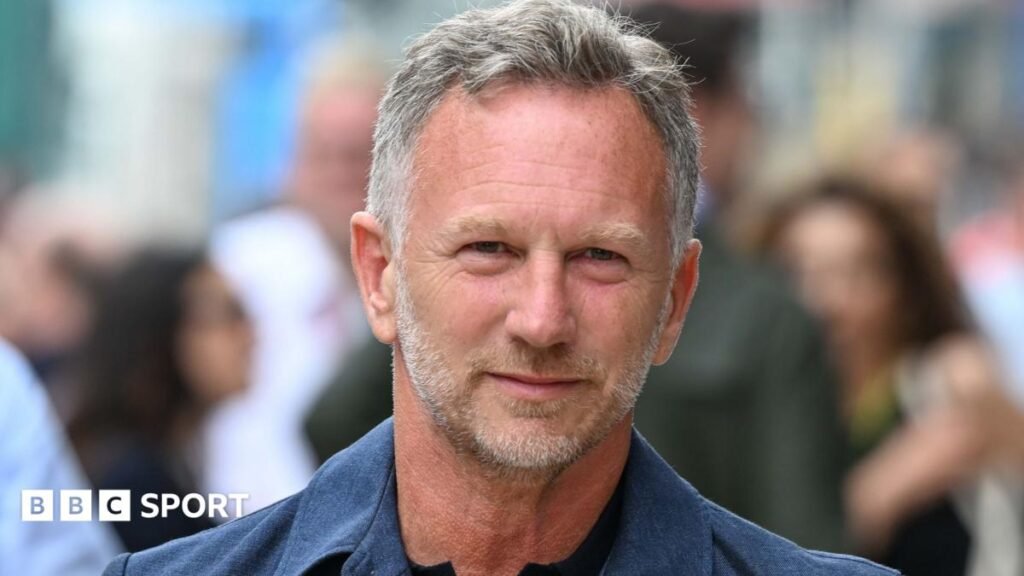
Does Christian Horner really want the team principal job at Ferrari, or even have a shot at it? – Ben
This topic has become a subject for conversation in recent days following an interview Horner did with the Times, external as he promotes his new book.
Horner said: “At this stage in my life, there’s only one team for which I would accept non-participation in ownership.”
Asked whether he would take a job there, he replied: “Would I consider Ferrari? I mean, Ferrari is the biggest brand in Formula 1. It’s the dream. And arguably it’s the sleeping giant of Formula 1.”
Ferrari team principal Frederic Vasseur made his views about Horner’s intervention pretty plain after the Azerbaijan Grand Prix when he said: “Mr Horner is looking for a job – that, everybody knows – everywhere.”
Vasseur said the speculation surrounding the team meant Ferrari were “not working in the perfect serenity”.
Horner’s comments seem to make it clear that he would consider a job offer from Ferrari. But the key questions are under what conditions he might accept it, and whether he would be offered it in the first place.
Horner has made it very clear over the years that he believes an F1 team needs one person in charge and in overall control.
It’s highly unlikely he would get that at Ferrari, where chairman John Elkann and chief executive officer Benedetto Vigna will always have more authority than any team principal.
Even at Red Bull, where Horner had theoretical leadership at the F1 team, he was ultimately answerable to headquarters in Austria and that is what led to his removal in the end.
It’s hard to imagine how Elkann and Vigna could or would countenance any situation where they were removed from any input into the F1 team.
And it’s even harder to imagine a situation where that was not the de facto position even if a team boss had been given assurances they would be left alone.
Then there is the question of whether Ferrari would want Horner.
Horner comes with baggage. All of the above for a start, and on top of that there is the cloud under which he left Red Bull.
There is no doubt that he was a remarkably successful team principal there, the team winning eight drivers’ titles, six constructors’ championships and 124 grands prix in his two-decade tenure.
However, the team unravelled in his final 18 months in charge, in the wake of the accusations of sexual harassment and coercive, controlling behaviour that were made against him by a female employee.
Red Bull dismissed those allegations after two internal investigations led by external lawyers.
But they were a key factor in Adrian Newey leaving his position as chief technical officer – along with internal politics in which Newey felt his role had been diminished by Horner.
Newey was followed out of the door by long-time sporting director Jonathan Wheatley and head of strategy Will Courtenay.
Horner was finally dismissed following a slump in form which Red Bull bosses concluded the team did not appear to be capable of arresting under his leadership.
In the Times interview, Horner says that the only justification he was given by Red Bull for his sacking was “it was more Christian Horner Racing than Red Bull Racing”.
He adds at other points in the interview: “I am a bit of a Marmite character. I know I’m not everybody’s cup of tea. It’s impossible to be.” And: “I’m the cure and the problem.”
Clearly, any decision as to whether Horner is the person you want to lead your F1 team would need careful consideration.
It’s also worth mentioning that Ferrari driver Lewis Hamilton has made it pretty clear over the past few years that he has little time for Horner.
Why hasn’t the FIA made a decision on the final two races of the season? They’ve cancelled the final rounds of the World Rally Championship and World Endurance Championship because of the Middle East conflict. Surely they should be confirming the changes in the calendar now? – Nigel
To start with a point of order, it is Formula 1 that decides the calendar – as in, the commercial rights holder – not the FIA, the governing body. The FIA’s role is effectively only to rubber-stamp F1’s decision.
As things stand, F1 is planning to end the season as the calendar was originally scheduled – with Las Vegas followed by Qatar and then Abu Dhabi, external over the last two weekends in November and the first in December.
Although the war continues between the US/Israel and Iran, the advice F1 has been getting is that the situation in those two countries is stable, and there is not a high risk of attacks on civilian infrastructure.
The UK Foreign Office, for example, does not advise against travel to Qatar and Abu Dhabi., external It simply says the situation there “remains unpredictable” and that “there is a risk of more attacks and unforeseen escalation in the region”.
And the two countries consider themselves open for business.
However, F1 has a contingency plan.
Imola in Italy is preparing to host a race on the weekend of Abu Dhabi.
If the two Middle Eastern races cannot happen as a result of an escalation of the situation in the Gulf, Imola would step in and hold the season finale on 4-6 December.
But unless and until that happens, there is no confirmation of changes to make, as there are currently no changes.
#Horner #Ferrari #Qatar #Abu #Dhabi #Grands #Prix #Bottas #Baku #crash #VSC #Williams #upgrade,
Source link


