





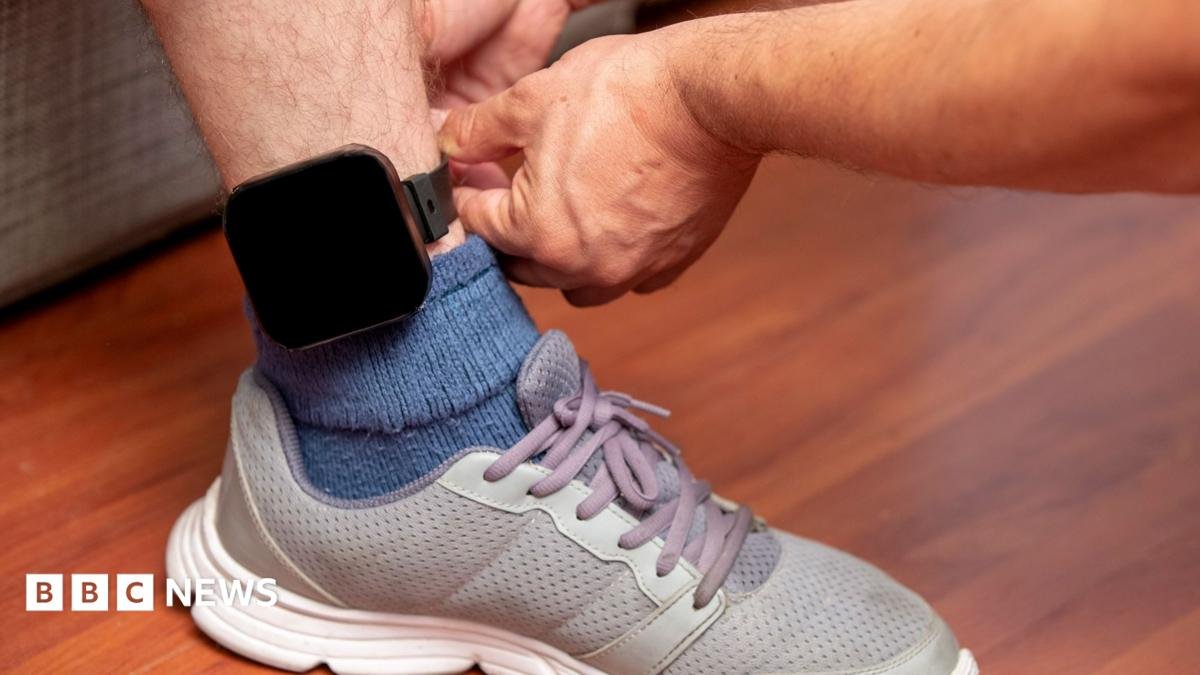
Delays in fitting tags on offenders putting victims at risk, report finds
BBC News
Almost half of electronic tags used to track offenders’ movements are not fitted on time, with significant delays putting victims in England and Wales at risk, a report has found.
The report by His Majesty’s Inspectorate of Probation (HMIP) says some criminals are waiting up to five months to be fitted with a tag, leading to repeated breaches of court and prison orders.
Only 55% of GPS and radio frequency tags were fitted on time, while 60% of alcohol monitoring tags were fitted promptly, according to the report’s findings.
A Ministry of Justice spokesperson said the government was delivering the “biggest expansion of tagging in British history” with £100 million in funding.
Electronic monitoring is used by the Probation Service to track curfews and conditions of a court or prison order.
A total of 27,847 people were given tagging orders with equipment in England and Wales as of June 2026.
“There is a real danger that electronic monitoring creates a false sense of assurance if the technology is not matched by effective professional practice,” said Martin Jones CBE, HM Chief Inspector of Probation.
“Expanding tagging programmes without addressing their weaknesses risks overpromising and underdelivering on public protection,” he added.
In some cases, there were waits of more than two weeks for the equipment while one in 10 people waited five months to be tagged after the required time.
Some of the reasons for tags not being fitted on time included individuals not making themselves available.
Victims’ Commissioner Claire Waxman OBE said victims needed to “know immediately” if tagging was delayed because this could give a “false sense of security”.
She said a “robust response” was required in the event of breaches but there were “real concerns” over how “overstretched” probation services would be able to handle this.
Data from the tags was often found to be underused with major violations raised and explored in just 46% of relevant cases, the report also found.
Inspectors discovered little evidence that electronic monitoring was being used consistently to promote behaviour change.
There are three types of tags:
curfew tags
location tags
alcohol tags
They include strict controls of an offender’s punishment to manage risk, safeguarding and the protection of victims.
Those who breach their orders either immediately return to prison, are given a court order or a formal warning.
A Ministry of Justice spokesperson said “public protection” was the government’s priority.
They said: “That’s why we are delivering the biggest expansion of tagging in British history, backed by £100 million in funding, with tag install rates up by nearly 50% since 2024.
“This is part of our record £700 million investment in probation and community services, recruiting 2,300 trainee officers over the last two years and a further 1,300 this year – ensuring dangerous offenders are kept under closer surveillance than ever before.”
Plans to significantly expand electronic monitoring were announced earlier this year as part of the Sentencing Act 2026, which aims to ease prison pressures by managing more offenders in the community.
Thousands more prisoners will be released early from October as part of the new law. Most will require tagging.
#Delays #fitting #tags #offenders #putting #victims #risk #report #finds,
Source link