
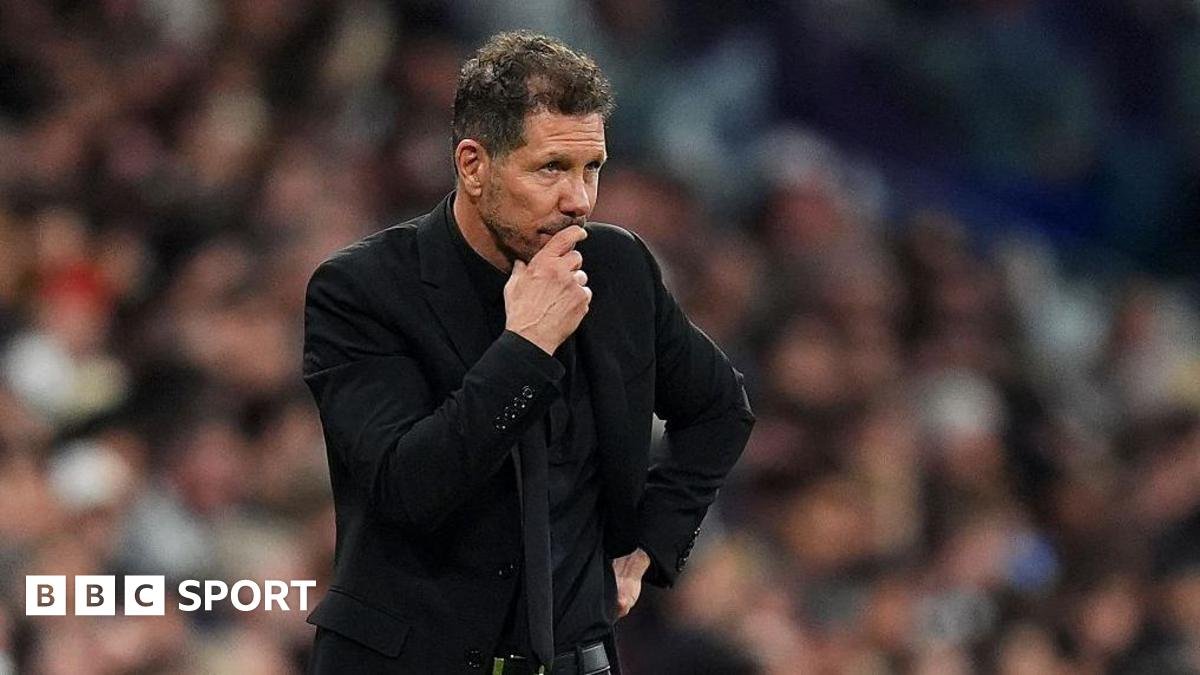

Atletico Madrid: What next for manager Diego Simeone?
One thing that is indisputable is Simeone’s managerial record at Atletico.
He has taken charge of Atletico Madrid on 786 occasions, recording 465 wins, 170 draws and 151 defeats across more than 14 and a half seasons at the helm. It makes him one of the longest-serving managers in world football.
Atletico offered Simeone his first big managerial job in European football when he was appointed in December 2011, his previous role on the continent having been to save Italian side Catania from Serie A relegation, following success in Argentina with River Plate and Estudiantes.
In that time, the club has been transformed. When Simeone first arrived, Atletico had just been eliminated from the Copa del Rey by third-tier Albacete and were 10th in La Liga, 21 points adrift of the leaders.
Yet under the Argentine coach, Atletico went on to win the Europa League in Simeone’s first season, before adding the Uefa Super Cup and the Copa del Rey in 2012–13.
From 2013-14 onwards, after winning their first title under Simeone, Atletico have qualified for the Champions League every season, twice falling to agonising final defeats at the hands of rivals Real in the space of three years between 2014 and 2016.
Competing on Europe’s biggest stage was no longer an achievement, it was considered the standard.
As Atletico supporter Guillermo Myela describes, Simeone changed the mentality of fans.
“We went from being ‘El Pupas – the jinxed ones’, to a club that can compete against Barcelona and Real Madrid without fear,” Myela says.
“The connection that he has with the club and the fans is something that you rarely see in modern football. He lives for Atletico Madrid.”
He is the most decorated manager of all time at the club and supporter Javier del Amo describes him as “one of the biggest icons in our history”.
“One of his biggest achievements is getting the fans identified again with the team,” del Amo says.
Lifelong supporter Dani Ruiz agrees: “He is the epitome of Atletico and what modern football has become.”