Private credit’s cracks spark a new tug of war with Wall Street banks


Wall Street, Manhattan, New York.

Andrey Denisyuk | Moment | Getty Images

Wall Street banks may finally be getting a long-awaited opening to claw back market share from private credit lenders.

After a decade in which private credit lenders grew rapidly and took over a large share of financing for leveraged buyouts, signs of strain in that sector, along with easing bank rules, may now be shifting the balance.

“This is an opportune time for banks to regain market share from private credit funds,” Moody’s chief economist Mark Zandi told CNBC in an email.

“Interest rates have declined and banking regulation has eased. Private credit lenders are also struggling with the fallout from their previously aggressive lending,” he highlighted.

Private credit’s rapid ascent was fueled in part by banks’ retreat. Following the Federal Reserve’s aggressive rate hikes and the 2023 banking crisis, lenders tightened underwriting and pulled back from riskier deals. Borrowers, particularly private equity firms, increasingly turned to direct lenders offering faster execution and looser terms.

The tug of war is just starting. The rules have been relaxed, so it’s only natural that banks want to get back some of their market share in private credit.

Jeffrey Hooke

Johns Hopkins Carey Business School

At its peak, the shift was dramatic. According to PitchBook data, banks’ share of buyout financings above $1 billion fell to just 39% in 2023, down from about 80% in the five years prior. That share has since recovered to just over 50% in 2025.

And the tide may be turning further.

Private credit is facing mounting challenges. Years of aggressive lending are starting to backfire, as higher interest rates make it harder for heavily indebted borrowers to repay loans and increase default risks. Investor demand for liquidity is also rising, with some clients seeking to pull money after years of locking up capital.

Moody’s Zandi expects the sector to “experience more credit problems in the coming months,” citing fallout from geopolitical tensions, higher borrowing costs and structural pressures in industries such as software. Consumer and healthcare borrowers may also come under strain.

Regulatory changes offering tailwinds

Over the medium term, regulatory changes could also further tilt the playing field. 

“Our anticipation of deregulation from the Trump administration includes a likely weakening of the Basel III Endgame implementation, with the U.S. Treasury explicitly aims to redirect business lending back into the banking sector,” Shannon Saccocia, chief investment officer at Neuberger Berman, told CNBC via email.

The Basel III “Endgame” framework is a regulatory overhaul finalized in 2017 in the wake of the 2008 global financial crisis. It was designed to standardize how large banks calculate risk and to establish a capital floor that requires lenders to hold more reserves against loans, particularly higher-risk corporate and leveraged lending.

This is the start of a big crisis for private credit, says Verdad's Rasmussen

That has made bank lending less competitive versus private credit funds in recent years, said market veterans.

A weakening or reversal in the Basel III Endgame will raise competition for private credit lenders, Saccocia added, a stance echoed by other market veterans.

“Banks should quickly fill any void left by more cautious private credit lending, said Zandi, pointing to a more favorable regulatory backdrop and improving funding conditions for traditional lenders.

Recent Federal Reserve proposals to adjust the regulatory capital framework could “position banks to be more competitive on the lending front in hopes of regaining at least some share of their original commercial banking foothold,” noted Lukatsky.

Recent deals, such as the multi-billion-dollar leveraged loan financings for Electronic Arts and Sealed Air, signal a strong appetite among banks to execute “jumbo” transactions when market conditions allow.

Private credit still competitive

However, private credit’s grip is far from broken just yet. Direct lenders continue to compete aggressively, offering unitranche loans that bundle different types of debt into one package at a single interest rate.

Blackstone and Ares, for example, were among 33 lenders that reportedly provided about $5 billion in financing to back investment firm Thoma Bravo’s acquisition of logistics company WWEX Group, underscoring how private credit firms can still fund large buyout deals even as banks begin to re-enter the market.

Pitchbook’s global head of credit and U.S. private equity Marina Lukatsky noted that the expected rebound in buyouts and dealmaking has yet to materialize this year, as uncertainty around trade policy, interest rates and geopolitics has slowed activity. With fewer deals taking place, demand for financing has declined across both banks and private credit.

For banks to make a meaningful comeback, borrowing costs in syndicated loans, which are large loans arranged by banks and funded by a group of lenders, need to become more competitive, she added. Additionally, large buyout activity needs to pick up, and the broader economic outlook needs to improve.

Crucially, private credit retains structural advantages that are difficult for banks to replicate, including speed, certainty of execution and flexible conditions, which some borrowers may continue to value in volatile markets, noted some experts.

That said, a comeback is on the cards.

“The tug of war is just starting,” said Jeffrey Hooke, senior lecturer in finance at Johns Hopkins Carey Business School 

“The rules have been relaxed, so it’s only natural that banks want to get back some of their market share in private credit.”

Choose CNBC as your preferred source on Google and never miss a moment from the most trusted name in business news.


Source link

FedEx (FDX) Q3 2026 earnings


Barclays' Brandon Oglenski breaks down FedEx's Q3 results

FedEx on Thursday reported strong fiscal third-quarter results that beat Wall Street’s expectations.

The company also raised its guidance for fiscal 2026, projecting revenue growth of 6% to 6.5% compared with analyst estimates of up 5.6%.

Shares of FedEx rose roughly 9% in extended trading.

Here’s how the company performed in the fiscal third quarter, compared with what analysts were expecting, according to LSEG:

  • Earnings per share: $5.25 adjusted vs. $4.09 expected
  • Revenue: $24 billion vs. $23.43 billion

For the quarter, FedEx reported adjusted operating income of $1.68 billion, beating estimates of $1.39 billion. It reported net income of $1.06 billion, or $4.41 a share, up from $909 million, or $3.76 a share, a year ago. Adjusted for spin-off costs and other one-time items, FedEx reported EPS of $5.25.

The company also raised its fiscal 2026 adjusted EPS expectations, now projecting earnings of $19.30 to $20.10 per share compared with previous guidance of between $17.80 and $19 a share.

“Team FedEx delivered another quarter of strong financial results and excellent service for our customers, powered by disciplined operational execution, the resilience of our global network, and the accelerating impact of our advanced digital solutions,” CEO Raj Subramaniam said in a statement.

The company previously said it expected roughly $1 billion in cost reductions from its “Network 2.0” initiative, which is focused on optimizing efficiency of its package processes by leveraging automation and artificial intelligence. FedEx now expects those savings to exceed $1 billion.

FedEx said its freight business, FedEx Freight, remains on track to be spun off into a separate publicly traded company on June 1.

Subramaniam said on a call with analysts that the company expects “modest” headwinds from disruptions from the Iran war and that the Middle East is a “relatively small part” of total revenue.

Choose CNBC as your preferred source on Google and never miss a moment from the most trusted name in business news.


Source link

Buy this steel stock that’s ‘largely insulated’ from Iran war, says UBS


Source link

Market’s ability to forecast world in question


Is the market’s ‘crystal ball’ broken? Experts on what current market signs are indicating

Investors may want to take a step back as stocks swing amid rising geopolitical tensions.

DBi’s Andrew Beer suggests the market’s crystal ball is broken.

“It’s not normal for big markets to move as much as they are right now,” the firm’s managing member told CNBC’s “ETF Edge” this week. “Something is deeply wrong in the market’s ability to forecast the state of the world… The only thing we can all do as investors is: This is the moment to plan and to prepare for the worst. You hope for the best.”

Beer, who has spent more than three decades in the hedge fund industry, thinks it’s remarkable the number of stresses on the financial system over the past 12 to18 months hasn’t caused things to spin out of control.

“You just you have more geopolitical risks stacked on top of each other today [and] more economic risk factors than I remember at any time in my career,” he added.

Beer urges investors to ask themselves how they would act if a 2008 or 2022 market downturn happens again.

“These financial assets are, they’re an investment, but they’re also what you need to survive, to live on, to retire, and so it’s the very real human side of it that I hope people will focus on,” he added.

According to Beer, investing like it’s 2025 could turn into regret.

“The best thing to do in 2025 was just turn off your computer beginning of the year and come back at the end of the year, and you’ve made money, your stocks and your bonds and everything else,” he said. “It won’t continue like that. We will go through a more difficult period.”

Recent moves in gold, silver, bitcoin and crude oil underscore how difficult it has become for investors to calibrate portfolios, especially as sharp reversals unfold over short periods of time, according to Beer.

“No one has a playbook for that,” said Beer, who is also watching for signs of strain in private credit, insurance company portfolios and other corners of the market where unusual stress could begin to spread.

NovaDius Wealth Management’s Nate Geraci highlighted exchange-traded funds that are designed to offer portfolio protection — particularly managed futures ETFs.

“This is absolutely something that is a longer-term allocation, and I almost view it as portfolio insurance,” the firm’s president said in the same interview. “You want that insurance when something goes bad in the market, and maybe that’s stocks and bonds going down together.”

Choose CNBC as your preferred source on Google and never miss a moment from the most trusted name in business news.


Source link

Salesforce issues $25 billion in debt to buy back stock. Should we be concerned?


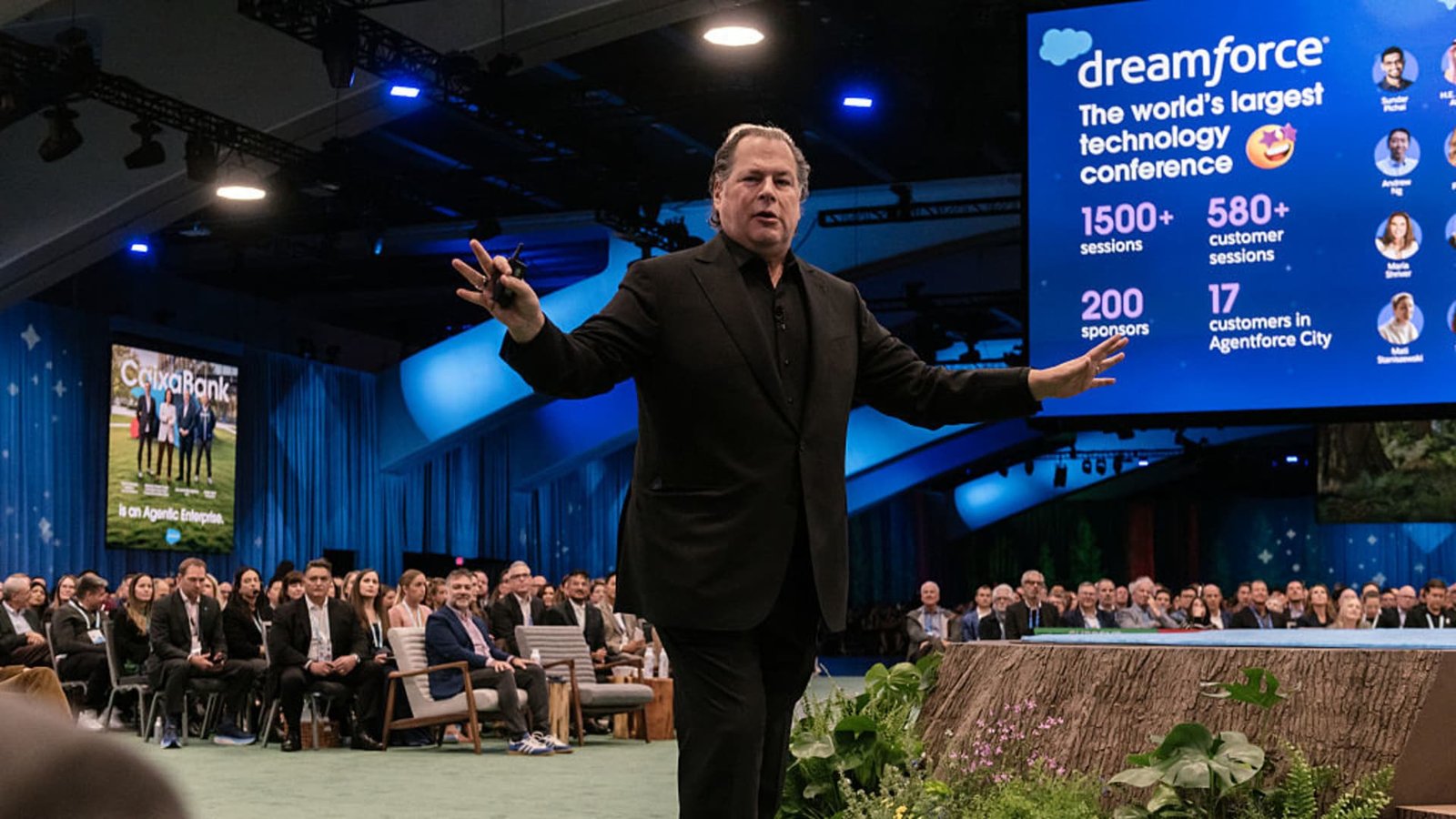
Marc Benioff, chief executive officer of Salesforce Inc., speaks during the 2025 Dreamforce conference in San Francisco, California, US, on Tuesday, Oct. 14, 2025.

Michael Short | Bloomberg | Getty Images

Salesforce announced this week that it executed the first steps in its debt-fueled $25 billion accelerated stock buyback plan. That’s half of the bigger $50 billion repurchase authorization approved in February.

Raising debt to repurchase stock is a move that deserves scrutiny.

After all, equity comes with neither the financial obligations nor the consequences of issuing debt. If a company misses a stock dividend payment, it doesn’t look good, and the stock will get hit. However, there are no legal consequences or claims to be filed. If a company defaults on debt, it will face legal issues and claims from bondholders.

We know why Salesforce wants to repurchase stock — management believes that last month’s brutal sell-off on AI disruption fears has made the share price attractive — because, as CEO Marc Benioff said in Monday’s press release: “We are so confident in the future of Salesforce.” (Salesforce insiders are also buying. Board member and Williams-Sonoma CEO Laura Alber purchased about $500,000 worth of Salesforce stock on Thursday, and David Kirk, also a director and former chief scientist at Nvidia, picked up roughly $500,000 worth of Salesforce stock on Wednesday.)

So, why is Salesforce issuing debt to buy back stock? Part of it may be that Benioff and company want to conserve cash. But mainly, it comes down to the cost of equity versus the cost of debt. CNBC Investing Club Reporter Paulina Likos and I actually touched on this concept briefly in a recent video about discounted cash flow valuation modeling. While the video was more focused on terminal value, we did cover the concept of a discounted rate, or the required rate of return an investor demands for investing in a given security. We noted that individual investors can and should use whatever rate they deem appropriate for the risk they are considering.

‘Shark Tank’ analogy on cost of capital

This stuff can be pretty complicated. In an oversimplified “Shark Tank” analogy, imagine you are starting a business. You need to figure out how to fund it. You can either give the sharks a percentage of your business (equity) or take a bank loan (which comes with the financial obligation to repay the principal plus interest). That decision is predicated on the cost of each — the interest rate on the loan (cost of debt) versus what you think that equity stake can generate (because you’re giving up the equity, this is your “cost of equity”). The ultimate goal, whichever route you go, is to fund your business with the lowest possible overall cost of capital.

For companies on Wall Street, however, the discount rate is often their own “weighted average cost of capital,” or WACC. The WACC is the weighted average of the cost of debt and equity required to fund the company.

Weighted average cost of capital

Breaking it down:

  • V = Total value is equity plus debt
  • E = Market value of equity (E/V is the weight of equity in the capital structure)
  • D = Market value of debt (D/V is the weight of debt in the capital structure)
  • Ce = Cost of equity
  • Cd = Cost of debt
  • T = Corporate tax rate

Don’t worry too much about how to calculate this. The real purpose is to look at what goes into the equation to better understand how corporations think about achieving the most efficient capital structure, meaning the lowest possible WACC. The lower the discount rate — WACC in this case — the higher the present value of future earnings and cash flows. The takeaway: Any increase in the weight of the lesser-priced asset — equity or debt — can reduce WACC. That is, until the point at which investors start to be concerned with the leverage on the balance sheet and begin to express that concern by demanding a higher return on equity, driving the stock lower, and the company’s cost of equity higher.

Cost of debt

So, what’s lower for Salesforce: cost of equity or cost of debt? Figuring the debt part is easy enough because Salesforce told us what yield they are paying on the bonds. That’s what the following slide shows.

Referring back to the earlier WACC equation, the cost of debt is multiplied by one minus the tax rate to reflect that companies get a tax deduction on debt interest payments. So, the actual cost of debt is lower than what is represented on the slide. Don’t worry about how much lower, just know that based on the WACC calculation, the true cost of debt is the yield seen above multiplied by a number less than 1. So, at the highest level, on the notes that mature in 2066, Salesforce has a pre-tax cost of about 6.7% and post tax cost on the debt somewhere below that — maybe closer to about 5.3%, assuming a 22% corporate tax rate.

Cost of equity

Now that we know what the most expensive portion of this debt raise will cost Salesforce, let’s figure out what its cost of equity is. To do this, the capital asset pricing model (CAPM) is used. Here is the calculation:

Breaking it down:

  • Rf = Risk-free rate — an often used proxy is the 10-year Treasury yield
  • β = Beta — a measure of systemic risk, is a stock’s volatility versus the index
  • Rm = Expected market return (Rm Rf is a calculation of market risk premium)

There is an equation for figuring out beta; however, most data providers already have it. We pulled the beta input for Salesforce from FactSet, rather than calculate ourselves. So, with Salesforce’s three-year beta of 1.21, the 10-year Treasury yield of 4.24% (as of this writing), and 8% as an expected market return, which is conservative, Salesforce’s cost of equity is around 9.27%. Since the cost of equity is much higher than the cost of debt, swapping out equity for debt lowers Salesforce’s weighted average cost of capital.

Bottom line

It’s understandable to question Salesforce’s debt-fueled stock buyback because it brings on new financial obligations at a time when the stock is saying the long-term prospects are in trouble due to AI. However, from the perspective of management, which clearly is not concerned about the long-term fundamentals, it’s a smart move to enhance the company’s capital structure by lowering the overall cost of capital. A lower WACC not only helps to increase present value by lowering the discount rate in Wall Street’s financial models, but it can also open up more investment opportunities because the hurdle to generate a positive return is lower.

The move may be rational, but whether it’s smart, only time will tell. Salesforce is trading out balance sheet optionality for a lower share count, which boosts earnings per share. But the strategy also results in a lowered credit rating by S&P Global due to increased leverage on the balance sheet. That means future debt will come at a higher cost.

It all hinges on whether Salesforce can service the debt, and that likely comes down to who is right on the AI debate. If Salesforce actually does get replaced by Claude-like replacements (we don’t think that will be the case but it’s clearly what the market fears), then the debt will get harder to service, investors will grow even more concerned now that the balance sheet has been levered up, and the stock likely declines — resulting in all of this being not only a total waste of money but a financial anchor as well. On the other hand, should management be proven correct and Salesforce does grow through this and actually benefits from AI, then this move will strengthen the company’s capital structure.

While the credit rating ding remains troubling, it can be reversed if all works out, as management will be able to pay back the debt, deleverage the balance sheet, and improve overall financial credibility. The move would also increase the reward should the bulls be proven correct by ensuring that shareholders all own a bit more of the company than they did previously, thanks to the retirement of the shares that this debt will repurchase.

(Jim Cramer’s Charitable Trust is long CRM. See here for a full list of the stocks.)

As a subscriber to the CNBC Investing Club with Jim Cramer, you will receive a trade alert before Jim makes a trade. Jim waits 45 minutes after sending a trade alert before buying or selling a stock in his charitable trust’s portfolio. If Jim has talked about a stock on CNBC TV, he waits 72 hours after issuing the trade alert before executing the trade.

THE ABOVE INVESTING CLUB INFORMATION IS SUBJECT TO OUR TERMS AND CONDITIONS AND PRIVACY POLICY, TOGETHER WITH OUR DISCLAIMER.  NO FIDUCIARY OBLIGATION OR DUTY EXISTS, OR IS CREATED, BY VIRTUE OF YOUR RECEIPT OF ANY INFORMATION PROVIDED IN CONNECTION WITH THE INVESTING CLUB.  NO SPECIFIC OUTCOME OR PROFIT IS GUARANTEED.

Choose CNBC as your preferred source on Google and never miss a moment from the most trusted name in business news.


Source link

This AI marketing stock is a top gainer today. Goldman says there’s much more to go


Source link

Stocks making the biggest moves premarket: AZN, U, COIN


Source link

Revolut reports record 2025 profit as it gears up for U.S. push


British fintech Revolut on Tuesday reported a record annual pretax profit, as it ramps up plans to expand into the U.S. following its long-awaited granting of a full U.K. banking license earlier this month.

Profit before tax rose 57% to £1.7 billion ($2.3 billion) in 2025, compared to £1.09 billion in 2024. Group revenue increased by 46% to $6 billion, which the company said was in part due to the performance of its business banking services, accounting for 16% of total income.

The startup, which hit a $75 billion valuation in 2025, is one of Europe’s most valuable private tech companies. Founded in 2015, Revolut says it operates in 40 markets globally.

“We have built a diversified, resilient business that is profitable at scale, providing the foundation for our next phase of growth,” said Cofounder and CEO Nik Storonsky in a statement.

“As we transition into a truly global bank, we are proving that our technology-driven operating model continues to drive rapid expansion and record profitability. A decade into this journey, we have only just begun to show what is possible.”

Total customer balances rose 66% to $67.5 billion as Revolut’s retail customer base grew by 30% to 68.3 million and business customers increased 33% to 767,000.

The neobank says it wants to reach 100 million customers by mid 2027.

U.S. push

Earlier in March, Revolut announced it had secured a full U.K. banking license after a lengthy back-and-forth between the company and the Prudential Regulation Authority.

It unlocks Revolut’s ability to offer a new range of products in the country, including lucrative lending, a market dominated by traditional banks. Revolut also launched full banking operations in Mexico in January.

The company is now gearing up for major global expansion.

Geographic growth beyond Europe will become the “next frontier of focus” for the company once it finalizes the launch of a U.K bank, Chief Financial Officer Victor Stinga said in a conference call with media.

Revolut filed for a U.S. Bank Charter in March, which if granted, would mark another significant regulatory milestone. The charter would allow the company to operate across all 50 U.S. states under one regulatory framework, alongside offering personal loans and credit cards.

Choose CNBC as your preferred source on Google and never miss a moment from the most trusted name in business news.


Source link