AI News
- Dividend growth stocks offer attractive returns and less risk, per Nuveen
- Canadian pharmacy platform to offer India-sourced Ozempic to US patients

- Truebit Token Price Falls 99% after Reports of $26M Exploit

The TRU price fell to $0.0000000029 from $0.16 after the protocol reported a security incident and crypto sleuths tracked stolen Ether.
The Truebit protocol reported a security incident “involving one or more malicious actors” with a smart-contract address suggesting the loss of $26 million worth of Ether.
In a Thursday X post, Truebit said it was in contact with law enforcement and “taking all available measures” following the security incident. Crypto sleuths monitoring the protocol reported that the exploit had resulted in the removal of 8,535 Ether (ETH), worth about $26.6 million at the time of publication.

Source: Truebit The affected smart contract address provided by Truebit showed only small amounts of ETH stolen. However, analysis from Lookonchain and other sleuths signaled that the total amount of crypto stolen in the attack was worth more than $26 million.
It’s unclear what led to the multimillion-dollar exploit or whether user funds were at risk. Cointelegraph reached out to Truebit for comment on the incident, but had not received a response at the time of publication.
Related: Gnosis announces hard fork to recover funds from Balancer exploit
Almost immediately following reports of the exploit, the price of the Truebit (TRU) token plummeted to an all-time low. According to data from Nansen, the TRU price fell more than 99% to $0.0000000029 from about $0.16 at the time of writing.
Truebit hack follows major exploits in 2025
December saw several significant hacks and exploits resulting in millions of dollars worth of digital assets stolen.
The Flow Foundation reported that an attacker had managed to counterfeit tokens on the network on Dec. 27, resulting in about $3.9 million in losses. Hackers also targeted Trust Wallet’s Chrome browser extension using a malicious update to steal $7 million.
Despite these incidents, blockchain analytics platform PeckShield reported on Jan. 1 that the total losses across the crypto industry due to exploits and hacks dropped to $76 million in December from $194 million in November .
Magazine: How crypto laws changed in 2025 — and how they’ll change in 2026
Source link - Stephanie Link says this oil stock is cheap and poised to benefit from the data center boom

- Temple Digital Group Launches Institutional Trading Platform on Canton

Temple Digital Group has launched a private, institutional trading platform built on the Canton Network, offering continuous, 24/7 trading of digital assets using a central limit order book and non-custodial market structure.
According to an announcement shared with Cointelegraph on Thursday, the platform supports trading in cryptocurrencies and stablecoins and is designed to allow institutions to transact with approved counterparties while maintaining privacy and regulatory oversight, with participants retaining custody of assets rather than relying on a central intermediary.
The system is built around a price-time priority central limit order book with sub-second matching and includes execution monitoring and transaction cost analysis tools intended for institutional trading desks, the company said.
The platform is live and onboarding institutional users, including asset managers, market makers and financial institutions, with support for tokenized equities and commodities planned for 2026.

Top blockchains for tokenized real-world assets. Source: RWA.xyz Temple Digital Group is a New York–based digital asset infrastructure company that builds non-custodial trading infrastructure for institutional digital asset markets.
The Canton Network is a permissioned blockchain created by Digital Asset that allows regulated institutions to transact and settle tokenized assets onchain.
Related: Digital Asset raises fresh funding to scale Canton Network adoption
Institutional adoption accelerates on the Canton Network
The Canton Network drew increased institutional attention in late 2025, as companies announced new deployments involving tokenized funds, collateral and financing infrastructure.
In December, Franklin Templeton expanded its Benji tokenization platform to Canton, allowing its tokenized US government money market fund to be used as collateral within Canton’s institutional ecosystem. The fund held $828 million in assets at time of writing, according to industry data.

Tokenized US Treasury Funds. Source: RWA.xyz On Dec. 9, Canton Network’s creator, Digital Asset, and a group of major financial institutions completed a second round of onchain US Treasury financing on Canton. The trial showed that tokenized Treasurys can be reused as collateral in real time, highlighting how blockchain-based infrastructure can reduce frictions in traditional collateral and financing markets.
About a week later, the Depository Trust and Clearing Corporation (DTCC) said it plans to mint a subset of US Treasury securities on the Canton Network, extending blockchain-based settlement into market infrastructure that processed $3.7 quadrillion in transactions in 2024.
On Wednesday, Digital Asset and Kinexys by JPMorgan announced plans to bring JPMorgan’s US dollar deposit token, JPM Coin, natively onto the network.
The Canton Coin (CC) has risen sharply recently. It is up more than 40% over the past two weeks and more than 80% over the past month, according to CoinGecko data at the time of writing.

Source: CoinGecko Magazine: Davinci Jeremie bought Bitcoin at $1… but $100K BTC doesn’t excite him
Source link - These stocks are going to see the biggest revenue boost

- Morgan Stanley to launch digital asset wallet as part of crypto product expansion

Morgan Stanley has plans to launch a digital asset wallet in 2026 as the financial services giant continues expanding its crypto investment product offerings to clients.
The wallet is built to support cryptocurrencies and real-world tokenized assets (RWAs), including stocks, bonds and real estate, with plans to support more assets over time, according to Barron’s.
In September, the company announced that it would allow users of the E*Trade brokerage platform, which it owns, to trade cryptocurrencies including Bitcoin (BTC), Solana (SOL) and Ether (ETH) in 2026.

The total value of tokenized real-world assets is broken down by asset class. Source: RWA.XYZ Cointelegraph reached out to Morgan Stanley for comment but had not received a response at time of publication.
The announcements show that crypto and blockchain technology are gaining widespread adoption from established financial institutions in the traditional finance world.
Related: Morgan Stanley’s Bitcoin ETF could offer strategic value beyond inflows, analysts say
Morgan Stanley pushes further into cryptosphere
Morgan Stanley announced several crypto-related developments for 2026, including several crypto exchange-traded fund (ETF) filings.
The company filed applications with the US Securities and Exchange Commission (SEC) on Tuesday to issue spot BTC and SOL ETFs, which would be “passive” investment funds tracking the spot price of these cryptocurrencies by holding them.
Morgan Stanley also filed for a staked Ether ETF on Tuesday that would hold spot ETH while staking an undisclosed portion of the fund’s ETH to earn staking income.

Morgan Stanley’s S-1 form for an Ethereum ETF. Source: SEC Staking is the process of pledging or locking up tokens to secure proof-of-stake blockchain networks, which can either be done directly as a validator processing transactions or through third-party delegation with a staking services provider.
Users who stake tokens are paid in the token of the blockchain they are securing — not fiat currencies or stablecoins.
Morgan Stanley initially offered crypto investment products to wealthy clients with at least $1.5 million in investible assets. In October, the company pivoted to allow all clients to invest in crypto products.
The company began recommending “conservative” crypto allocations in October. Morgan Stanley analysts recommended up to a 4% allocation for higher risk portfolios geared toward growth and a 2% allocation for “balanced risk” portfolios.
Magazine: Solana vs Ethereum ETFs, Facebook’s influence on Bitwise: Hunter Horsley
Source link - Exclusive-Big Tech spared strict rules in EU digital rule overhaul, sources say

- Some of Warner Bros’ biggest investors are split on Paramount offer

- Czech defense firm CSG plans IPO in Amsterdam next week – Bloomberg
- CrowdStrike to buy identity security startup SGNL for $740 million to tackle AI threats

- Alibaba, Costco among market cap stock movers on Thursday
- Brazil 2025 eggs exports soar on strong US demand

- Exclusive-Trump, Congress move to undo Biden-era ban on mining in northern Minnesota

- What they’re buying in 2026 after strong year

Various Halliburton equipment being stored at the equipment yard in Alvarado, Texas.
Cooper Neill | Reuters
Fresh off a bumper 2025, retail investors are rushing back into the market with a focus on energy stocks.
Everyday traders bought at the second-highest level in almost eight months at the start of 2026’s trading year, according to a JPMorgan report released Wednesday. Oil-related stocks were a particularly hot pick for mom-and-pop investors following the U.S.’ weekend strike on Venezuela, data shows.
“Retail investors favored some of the companies that can immediately profit from the potential return of Venezuelan heavy crude to the [U.S] or those needed to rebuild the country’s decaying oil infrastructure,” Arun Jain, JPMorgan’s quant analyst, told clients.
Net daily retail inflows into Halliburton spiked to the highest level since early 2022, according to market research firm VandaTrack. Flows into Chevron — which Wall Street quickly crowned a key beneficiary of the military intervention — hit highs going back to summer, the firm found.
Beyond those stocks, JPMorgan found surging retail inflows into fellow oil industry stalwarts such as Baker Hughes and SLB as investors wondered what’s next for the global industry.
Venezuela sits on the largest proven crude oil reserves in the world, but output has dropped significantly from its peak in the late 1990s. President Donald Trump said the South American country would ship up to 50 million barrels of oil to U.S. following the strike. American forces captured Venezuelan President Nicolás Maduro and his wife and brought them to the U.S. on drug trafficking charges.
To be sure, it’s not yet clear if these big bets from average-Joe traders in the wake of the Venezuela action will pay off long term. Halliburton, SLB and Baker Hughes shares have jumped this week, while Chevron has whipsawed following a big Monday rally.
Stock Chart Icon Stock chart icon
Oil stocks over the last five days
But pullbacks don’t necessarily mean retail traders will abandon the theme, according to Viraj Patel, deputy head of research at Vanda. If oil plays out for these investors like the popular artificial intelligence trade, they will likely hang around for the ride.
“Once retail gets its teeth into a theme, they don’t let go — like a dog with a bone,” Patel said. “AI showed us that if retail believes in something, they’ll keep buying even on bad days.”
This interest in energy can also signal a shift away from high-growth names to those with more cash flow generation, according to Patel. Retail trading also picked up for oil-focused exchange-traded funds like the State Street Energy Select Sector SPDR ETF (XLE), he said.
Retail’s next test
Energy could mark the latest test for a group whose strong performance last year is creating a narrative shift among big investors.
JPMorgan’s Jain reported record retail flows in 2025, with everyday investors rushing into the SPDR Gold Shares (GLD) fund and AI stocks like Nvidia and Palantir — all of which rallied sharply. Overall annual inflows were close to double the five-year average and almost 60% higher than in 2024, per the bank’s data.
Retail traders’ jump into equities to start the new year follows a seasonal slowdown in the last week of 2025, Jain added.
Small investors bought the dip successfully at early points in the year, allowing them to ride the market’s dramatic midyear rebound to all-time highs, according to Vanda and JPMorgan. Because of that, their reputation has moved away from the “dumb money” caricature defined by meme stock surges and short squeezes toward a one of more mature market participant.
“Institutional investors are no longer asking how to fade retail,” Patel said. “They’re asking, ‘What are they seeing that we’re not?'”
Source link - Earnings call transcript: PriceSmart misses EPS but beats on revenue in Q1 2026
- Regional banks are well set up entering 2026, with one set to be a big winner, says Jay Woods

- Coincheck Group to Acquire Digital Asset Manager 3iQ in $112M Stock Deal

Coincheck Group, the Nasdaq-listed holding company behind one of Japan’s largest cryptocurrency exchanges, has agreed to acquire a 97% stake in Canadian digital asset manager 3iQ from its majority owner, Monex Group.
The stock-purchase transaction values 3iQ at $111.84 million, using Coincheck Group shares priced at $4 each. Coincheck Group said it intends to offer the same terms to 3iQ’s minority shareholders, which would give it full ownership if the deal is completed.
The deal is expected to close in the second quarter, subject to regulatory approvals and other customary conditions.
Founded in 2012, 3iQ is a Canada-based digital asset manager that provides regulated cryptocurrency exposure through traditional investment products. The company was an early entrant in exchange-listed crypto funds and later expanded into staking-based exchange-traded funds (ETFs) and managed crypto strategies primarily for institutional investors.
Coincheck is a Japan-based cryptocurrency exchange launched in 2014 that offers regulated retail trading and custody services. In December 2024, it became the first Japanese cryptocurrency exchange to list on the Nasdaq.
According to the announcement, the 3iQ deal follows Coincheck Group’s recent expansion through acquisitions, including its October purchase of Paris-based crypto prime broker Aplo SAS and its March acquisition of staking services provider Next Finance Tech Co., as the company builds out its institutional and international operations.
Related: Binance acquires regulated crypto exchange in Japan
US-based crypto exchanges make acquisitions
Recent acquisitions by Coincheck reflect a broader effort by crypto exchanges to diversify revenue beyond trading fees and expand into adjacent businesses.
In 2025, US-based exchange Coinbase made several acquisitions spanning infrastructure, consumer products and derivatives.
Early in the year, the exchange acquired Spindle, a blockchain-based advertising platform, and the team behind Roam, a Web3-focused browser. In July, Coinbase bought Liquifi, a platform used by early-stage token projects to manage compliance and token distribution.
Coinbase agreed in May to acquire Deribit for $2.9 billion, one of the largest deals in the sector, expanding its global derivatives business. To close the year, the company acquired The Clearing Company, adding onchain prediction markets to its product offerings.
Kraken also made several acquisitions in 2025, buying futures trading platform NinjaTrader in May to expand into traditional derivatives for US customers, followed by the August purchase of Capitalise.ai, a no-code trading automation startup.
In December, the company agreed to acquire Backed Finance AG, bringing tokenized equities issuance and settlement into its product suite.

Source: RWA.xyz Magazine: Davinci Jeremie bought Bitcoin at $1… but $100K BTC doesn’t excite him
Source link - Northern Technologies earnings beat by $0.02, revenue topped estimates
- Northrop Grumman launches digitally enhanced ICBM target vehicle
- BlackRock Buys $900M BTC as Long-Term Selling Hits 2017 Lows

BlackRock’s fresh round of Bitcoin (BTC) buying takes place alongside a sharp slowdown in long-term selling, a combination that points to cooling downside pressure after the recent market pullback in Q4.
Key takeaways:
BlackRock added nearly $900 million worth of Bitcoin in the first week of January, rebuilding exposure after an end-of-2025 drawdown.
Long-term Bitcoin holders are selling at their lowest rate since 2017, despite elevated prices.
Onchain data pointed to a possible accumulation phase among certain wallet cohorts.
Data from Lookonchain indicated BlackRock has accumulated Bitcoin for the past three days, adding 9,619 BTC valued at roughly $878 million. The asset management company currently holds about 780,400 BTC, worth $70 billion.

BlackRock’s BTC holdings. Source: Arkham Intelligence BlackRock’s BTC holdings peaked on Nov. 30 at around 804,000 BTC. At the time, that position was valued at roughly $96.5 billion. Although holdings fell to 771,000 BTC by Jan. 1, BlackRock has swiftly added close to 9,000 BTC during the first week of January.
The institutional buying coincided with a notable shift among long-term holders. Bitcoin’s Exchange Inflow Coin Days Destroyed (CDD) metric on Binance has fallen to its lowest level since 2017, signaling that older coins are barely moving onto exchanges.

Bitcoin exchange inflow CDD on Binance. Source: CryptoQuant For context, long-term holder supply dropped from over 15 million in July 2025 to 13.6 million in November 2025. Over the past couple of months, the long-term supply has not decreased further.
Signs of BTC accumulation as recent sellers step aside
Onchain data from CryptoQuant helps explain this shift. The SOPR Ratio, which broadly compares whether recent buyers and long-term holders are selling at a profit or loss, has dropped to levels associated with market resets. Newer participants are selling at losses, while long-term holders remain profitable and largely inactive.

Bitcoin SOPR LTH-STH dynamics. Source: CryptoQuant This pattern reflects a clean-up phase after sharp rallies, where speculative positions unwind, and coins change hands at lower prices. With Bitcoin down roughly 20% to 25% from its highs, this dynamic can mark the early stages of accumulation, provided selling pressure from recent buyers continues to drop.
Related: Morgan Stanley’s Bitcoin ETF could offer strategic value beyond inflows, analysts say
Bitcoin’s unrealized profit/loss data points to a reset
Bitcoin’s Net Unrealized Profit/Loss (NUPL) added another layer of context. The metric currently sits near the 0.3 level, a zone that has historically marked transitions from recovery into more constructive market conditions. Holders, on average, are back in moderate profit, but the market remains far from the excess seen near major cycle tops.

Bitcoin net unrealized profit/loss. Source: CryptoQuant This positioning suggests a cautious transition phase rather than a clear breakout. Confidence appears to be rebuilding, but broader confirmation on both onchain and market structure would be needed before a stronger move.
Related: Bitcoin averages 100% return after down years: Will the pattern repeat in 2026?
This article does not contain investment advice or recommendations. Every investment and trading move involves risk, and readers should conduct their own research when making a decision. While we strive to provide accurate and timely information, Cointelegraph does not guarantee the accuracy, completeness, or reliability of any information in this article. This article may contain forward-looking statements that are subject to risks and uncertainties. Cointelegraph will not be liable for any loss or damage arising from your reliance on this information.
Source link - Buda Juice shares surge 60% in NYSE American debut
- Earnings call transcript: Commercial Metals beats Q1 2026 earnings forecast
- Morgan Stanley cuts Ball, sees better earnings revision upside at Crown
- Snowflake stock falls after announcing acquisition of Observe
- Earnings call transcript: AZZ Inc. Q3 2026 earnings beat expectations
- France stocks higher at close of trade; CAC 40 up 0.12%
- Why South Korea Can’t Agree on Who Should Issue Stablecoins

Key takeaways
Korea’s crypto bill is stalled over stablecoin issuer rules.
The central bank wants banks to remain in control, often framed as a “51%” threshold.
Regulators and lawmakers fear a bank-only model would limit competition.
Firms are lining up, with Toss planning a won-backed stablecoin once rules are finalized.
South Korea’s next major crypto law is being held up by a seemingly simple question: Who gets to issue a won-backed stablecoin?
The proposed Digital Asset Basic Act has slowed as regulators clash over whether stablecoins should be treated as bank-like money or as a licensed digital-asset product.
At the center is the Bank of Korea’s push for a “banks-first” model, ideally through bank-led consortia with at least 51% bank ownership, arguing that stablecoins could, in their view, spill over into monetary policy, capital flows and financial stability if they scale too quickly.
The Financial Services Commission and lawmakers, meanwhile, are wary that a bank-dominated regime could materially limit competition and slow innovation.
The standoff is now expected to push the bill into 2026.

Why Korea cares about won-stablecoins
Stablecoins in South Korea are already important to local traders who move value into crypto markets, often via dollar-pegged tokens to access offshore liquidity. If stablecoin use scales, it could amplify cross-border flows and complicate foreign-exchange management, especially in a market where crypto participation and retail exposure are unusually high.
That is why the Bank of Korea continues to frame issuer rules as a “financial stability” decision. Officials argue that a cautious, staged rollout, starting with tightly regulated banks, reduces the risk of sudden outflows or a loss of control over how “private money” circulates.
At the same time, policymakers who want more companies to be allowed to issue won-backed stablecoins view the issue as one of competitiveness. If Korea does not build a trusted local option, users will continue to rely on foreign stablecoins, leaving the country with less regulatory visibility and fewer opportunities to grow a domestic stablecoin industry.
Did you know? In the 12 months through June 2025, stablecoin purchases denominated in Korean won totaled about $64 billion in South Korea, according to Chainalysis.
The regulatory backdrop
South Korea’s first major crypto regulatory act was the Act on the Protection of Virtual Asset Users. It is built around market safety, including the segregation and custody of customer funds, with banks designated as custodians for user deposits. The framework also mandates cold-wallet storage, criminal penalties for unfair trading and insurance or reserve requirements to cover hacks and system failures.
However, that “phase 1” framework is mainly focused on how exchanges and service providers protect users. The unresolved dispute lies in the next step, the proposed Digital Asset Basic Act, where lawmakers and regulators aim to define stablecoin issuance, supervision and issuer eligibility.
This is precisely where the bill is bogging down. When Korea tries to answer the question of who can issue stablecoins, the Bank of Korea and the financial regulator diverge.
Did you know? South Korea’s crypto rules require licensed service providers to keep at least 80% of customer assets in offline cold wallets to protect against hacks and theft.
Three institutions, three incentives
South Korea’s stablecoin standoff is ultimately a dispute over which institution should have primary responsibility when private money becomes systemically important.
The Bank of Korea is approaching won-backed stablecoins as a potential extension of the payments system and, therefore, as a monetary policy and financial stability issue. Its senior leadership has argued for a gradual rollout that begins with tightly regulated commercial banks and only later expands to the broader financial sector to reduce the risk of disruptive capital flows and knock-on effects during periods of market stress.
The Financial Services Commission views the same product as a regulated financial innovation that can be supervised through licensing, disclosure, reserve standards and ongoing enforcement, without hard-wiring the market to banks as the default winners.
That is why the FSC has pushed back against the idea that issuer eligibility should be determined mainly by ownership structure and why leaked and proposed approaches have reportedly examined multiple models rather than treating bank control as the only safe option.
Then there are lawmakers and party task forces, who are weighing political promises, industry pressure and the optics of competitiveness.
Some proposals have contemplated relatively low capital thresholds for issuers, which the central bank has described as increasing instability risks. Others argue that a bank-first regime could simply delay product market fit and push activity toward offshore dollar stablecoins.
Even the “51% rule” debate has a local twist. The Bank of Korea has warned that allowing non-bank corporates to take the lead could collide with Korea’s long-standing separation between industrial and financial capital.
Did you know? Major Korean exchanges such as Bithumb and Coinone added USDT/KRW trading pairs starting in December 2023, making stablecoins easier to access directly with the won.
The “51% rule”: What it is, why it exists and why it’s controversial
In its strictest form, the Korean media-dubbed “51% rule” suggests that a won-backed stablecoin issuer should be a consortium led by commercial banks, with banks holding at least a 51% ownership stake. This structure would effectively ensure that banks control governance, risk management and, crucially, redemption operations.
The logic is that if stablecoins begin functioning like money at scale, they can influence monetary policy transmission, capital flows and financial stability. A bank-led structure is intended to import prudential discipline from day one, including capital standards, supervisory culture, Anti-Money Laundering (AML) controls and crisis management, rather than attempting to bolt those safeguards on after a non-bank issuer has already reached systemic size.
The opposition is just as direct. The Financial Services Commission and pro-industry lawmakers argue that hard-wiring bank control into the rules could reduce competition, slow experimentation and effectively shut out capable fintech or payments firms that might deliver better distribution and user experience.
Critics also point out that mandatory ownership thresholds are an indirect way to regulate risk and not the only one, given the availability of reserve requirements, audits, redemption rules and supervisory powers.
It’s not just about who issues stablecoins
Even if South Korea ultimately allows non-banks to issue won-backed stablecoins, regulators still have plenty of levers to prevent the product from exhibiting shadow-bank-like risk characteristics.
The government’s draft approach has focused on reserve quality and segregation, steering issuers toward highly liquid, low-risk backing such as bank deposits and government debt. Reserves would be held through third-party custody and structurally separated from the issuer to reduce bankruptcy spillover.
Then there is the “money-like” principle of quick redemption at par. Publicly discussed proposals include clear redemption rules and tight timelines, which are designed to prevent a stablecoin from turning into a gated fund during periods of market stress.
Korea’s broader regulatory posture already points in this direction. The Financial Services Commission has been building a user-protection regime around custody standards and strict operational requirements, such as offline storage thresholds for customer assets, showing that regulators are comfortable setting concrete technical guardrails rather than relying solely on licensing decisions.
Industry pressure and what to watch in 2026
There is urgency. The regulatory standoff is unfolding while the market is already preparing for won-backed stablecoins.
Major commercial banks are gearing up for a bank-led model, while large consumer platforms and crypto-native players are exploring how they could issue or distribute a won-pegged token if the rules allow it. Multiple banks and major companies are reportedly positioning for this market even as the policy debate drags on.
Fintech firms, however, do not want to operate inside a bank-controlled consortium. Toss is a clear example. The company has said it is preparing to issue a won-based stablecoin once a regulatory framework is in place, treating legislation as the gate that determines whether the product can launch.
This push and pull is why delays matter. The longer Korea debates issuer eligibility, the more everyday stablecoin activity defaults to offshore, dollar-based infrastructure, and the harder it becomes to argue that the slow pace reflects a deliberate choice rather than lost time.
So, what happens in 2026? Scenarios under consideration include:
Staged licensing, with banks first and broader participation later, is an approach the Bank of Korea has publicly supported.
Open licensing with a “systemic” tier, where larger issuers face heavier requirements.
Bank-led consortia that are allowed but not mandatory, easing the fight over the “51% rule.”
This article does not contain investment advice or recommendations. Every investment and trading move involves risk, and readers should conduct their own research when making a decision. While we strive to provide accurate and timely information, Cointelegraph does not guarantee the accuracy, completeness, or reliability of any information in this article. This article may contain forward-looking statements that are subject to risks and uncertainties. Cointelegraph will not be liable for any loss or damage arising from your reliance on this information.
Source link - Here are Evercore ISI’s best stock picks for 2026

- Primary Goal for 2026 is Crypto Market Structure

In a year in which the United States will hold elections that could upset the balance of power in Congress, a cryptocurrency advocacy organization backed by Coinbase said its first priority is to “help get federal digital asset market structure legislation signed into law.”
In its year-in-review report released on Thursday, Stand With Crypto (SWC) said it had added 675,000 people across the US to its advocacy efforts, bringing its total to 2.6 million.
Though SWC said it would continue to mobilize its members “to support pro-crypto candidates in the congressional races” as part of the 2026 midterm elections in the US, its “primary goal” was helping the digital asset market structure bill get through Congress.

Source: Stand With Crypto The bill, called the Responsible Financial Innovation Act (RFIA) in the Senate, is headed for a markup in the banking committee next week. Lawmakers on the Senate Agriculture Committee, drafting their own version of the bill, are also expected to schedule a markup in the near future.
Market structure for digital assets, if signed into law, is expected to be one of the most significant pieces of legislation impacting the crypto industry since its creation in 2009.
The CLARITY Act, which is the version of market structure passed by the US House of Representatives in July, and drafts of the RFIA showed that the bill could give the US Commodity Futures Trading Commission more authority in regulating digital assets.
Related: If history repeats itself, will the US Congress become more pro-crypto in 2026?
Mason Lynaugh, Stand With Crypto’s community director, told Cointelegraph in November that how lawmakers vote on the market structure bill could impact their reelection bids in 2026. All 435 seats in the House and 33 seats in the Senate are up for grabs, potentially allowing Democrats to regain majority control from the Republicans.
Representatives from crypto companies gathering on Capitol Hill on Thursday
Another advocacy group for crypto and blockchain, The Digital Chamber, announced that it would be facilitating talks between members of Congress and industry representatives on Thursday ahead of the markup for the market structure bill.
Some experts are still concerned that a potential government shutdown at the end of January could slow progress on the bill.
In October, US lawmakers failed to reach an agreement on a funding bill, shutting down many federal agencies and furloughing workers for 43 days, the longest in the country’s history. The event likely slowed progress on the market structure bill in the Senate after some Republican leaders predicted it would be signed into law by 2026.
Magazine: How crypto laws changed in 2025 — and how they’ll change in 2026
Source link - Earnings call transcript: Richardson Electronics Q2 2026 sees EPS miss, revenue beat
- Germany stocks mixed at close of trade; DAX up 0.01%
- What Top Crypto Companies Predict for Bitcoin in 2026


2026 could mark the clearest break yet from everything investors thought they understood about Bitcoin cycles.
For more than a decade, markets have leaned on the four-year halving model to predict peaks, crashes and recoveries.
Under that framework, 2025 should have marked the top, with 2026 shaping up as a painful down year. But a growing number of analysts now say that model is no longer reliable, and the next phase of crypto may look very different.
In a new Cointelegraph video, we break down fresh outlooks from four major crypto companies: Grayscale, Galaxy Digital, Bitwise and 21Shares, to explore what 2026 may hold.
Some forecasts are surprisingly bullish. Grayscale argues Bitcoin (BTC) could reach new all-time highs in the first half of 2026, driven by macro forces like rising global debt, fiat debasement and accelerating institutional adoption through exchange-traded products. If that happens, it would effectively invalidate the classic four-year cycle narrative.
Others urge caution. Galaxy describes the year ahead as “too chaotic to predict,” citing wide price ranges in options markets and looming uncertainties such as the US midterm elections and shifting monetary policy, even as it remains optimistic about the longer term.
Beyond Bitcoin’s price, the reports converge on several powerful trends shaping crypto’s next chapter: explosive growth in stablecoins, the rise of prediction markets tied to real-world events and increasing demand for privacy tools as crypto integrates deeper into mainstream finance.
To get the full breakdown including key data points, company-by-company predictions and the narratives most likely to define 2026, watch the complete video now on the Cointelegraph YouTube channel. And remember to like, subscribe and join the conversation in the comments.
Source link - Earnings call transcript: RPM International Q2 2026 misses EPS estimates
- Exclusive-Vitol gets preliminary US license to begin negotiations on Venezuelan oil imports and exports, four sources say


Exclusive-Vitol gets preliminary US license to begin negotiations on Venezuelan oil imports and exports, four sources say
Source link - Earnings call transcript: Lindsay Q1 2026 EPS Beats, Revenue Misses Expectations
- China’s Anta Sports has offered to buy Pinault family’s 29% Puma stake, sources say

- How Scarcity Is Being Repriced

Key takeaways
In 2026, scarcity is being repriced through narratives, market access and financial structures rather than simple supply limits.
Bitcoin’s scarcity is increasingly mediated by ETFs and derivatives, reshaping how it is accessed and priced in financial markets.
Gold’s scarcity is tied less to mining output and more to trust, neutrality and reserve management.
Silver’s scarcity reflects its dual role as both an investment metal and an industrial input.
In 2026, scarcity has taken on a different meaning. It is no longer defined solely by limited supply or production constraints. Instead, it increasingly depends on how narratives are constructed and combined, shaping how investors perceive value.
Bitcoin (BTC), gold and silver each assert scarcity in distinct ways. However, investors now tend to evaluate them not only by how rare they are but by how they function within modern financial markets. Considerations increasingly include narrative pricing, market structure and ease of access.
This article explores how the manner in which investors discuss Bitcoin, gold and silver is undergoing change. It discusses the role of different factors in determining the repricing of scarcity.
Repricing of scarcity: A framework
Repricing scarcity does not involve forecasting which asset will outperform others. Instead, it refers to how market participants reassess the meaning of scarcity and determine how much they are willing to pay for its different forms.
In past decades, scarcity was commonly understood as a physical constraint, and gold and silver naturally aligned with this definition. Bitcoin, however, introduced a new concept: scarcity enforced by programmable code rather than geological limits.
In 2026, scarcity is evaluated through three interconnected perspectives:
Credibility: Is the mechanism that enforces scarcity considered trustworthy?
Liquidity: How readily can a position in the scarce asset be entered or exited?
Portability: How easily can the value be transferred across systems and borders?
Each of these perspectives influences Bitcoin, gold and silver in distinct ways.
Bitcoin: From self-sovereign asset to financial instrument
Bitcoin’s scarcity narrative relies on fixed, preset rules. Its supply schedule is transparent and resistant to arbitrary change. This makes Bitcoin’s scarcity framework clear, allowing investors to see precisely how coin issuance will unfold years in advance.
In 2026, Bitcoin’s scarcity and demand are increasingly influenced by financial products, particularly spot exchange-traded funds (ETFs) and regulated derivatives. These instruments do not alter Bitcoin’s core rules, but they do reshape how scarcity is perceived in markets.
Many investors now access Bitcoin not on its blockchain but through associated products such as ETFs. This shift has contributed to a reframing of Bitcoin’s narrative, from a primarily self-sovereign digital asset toward a more financialized scarce instrument. While the underlying scarcity remains fixed, pricing increasingly reflects additional factors, including liquidity management and hedging activity.
Did you know? Bitcoin’s issuance schedule is capped at 21 million units, with new supply decreasing over time through programmed halvings.
Gold’s evolution from metal to global collateral
Gold has a long-standing reputation for scarcity. Mining it requires significant investment, and known reserves are well documented. In 2026, however, gold’s value depends less on mining output and more on the trust it inspires.
Central banks, governments and long-term investment managers continue to regard gold as a neutral asset, unlinked to any single country’s debt or monetary policy. The metal is traded in various forms, including physical bars, futures contracts and ETFs.
Each form responds differently to scarcity. Physical gold emphasizes secure storage and reliable settlement, while paper gold prioritizes ease of trading and broader portfolio strategies.
During periods of geopolitical tension or policy uncertainty, markets often revalue gold based on its perceived role as reliable collateral. Investors are not always seeking higher prices. Instead, they value gold’s ability to remain functional when other financial systems face strain.
Did you know? Central banks have been net buyers of gold in recent years, reinforcing gold’s role as a reserve asset rather than a purely speculative instrument.
Why silver defies traditional scarcity models
Silver occupies a distinct position in discussions of scarcity. Unlike gold, it is deeply integrated into industrial supply chains. Unlike Bitcoin, its scarcity is not governed by a fixed issuance schedule.
In 2026, silver’s scarcity narrative is shaped by its dual-use nature. It functions as both a monetary metal and an industrial input for electronics, solar panels and advanced manufacturing. This dual role complicates scarcity pricing. Industrial demand can constrain supply even when investor sentiment is weak, while financial flows can amplify volatility despite relatively modest physical shortages.
Silver’s market structure also plays an important role. Compared with gold, silver markets are smaller and more sensitive to futures positioning and inventory shifts. As a result, silver’s scarcity often manifests through sharp repricing events.
Did you know? Silver demand is split between investment and industrial use, with industrial applications accounting for more than half of annual consumption.
The role of ETPs in reframing scarcity
One of the most significant developments influencing scarcity narratives across all three assets is the growth of exchange-traded products (ETPs).
ETPs do not change an asset’s underlying scarcity. Instead, they expand access and allow market sentiment to drive investment flows more rapidly, influencing how prices adjust.
For Bitcoin, ETPs bring a digitally native asset into traditional financial systems.
For gold and silver, ETPs transform physical scarcity into instruments that behave like stocks and respond quickly to broader economic signals.
This indicates that scarcity is influenced not only by long-term holders but also by short-term traders, arbitrage strategies and portfolio adjustments. As a result, scarcity increasingly functions as a market attribute that can be traded or hedged, rather than simply held.
Did you know? Bitcoin ETFs allow investors to gain BTC exposure without holding private keys, meaning many now “own Bitcoin” through brokerage accounts that resemble stock portfolios rather than crypto wallets.
Navigating the derivatives-driven scarcity gap
Another factor complicating the repricing of scarcity is the role of derivatives markets. Futures and options contracts allow investors to gain exposure to an asset without owning it directly. This can create an impression of abundance even when the underlying physical or protocol-level scarcity remains unchanged.
In Bitcoin markets, derivatives often play a significant role in short-term price movements. In precious metals markets, futures trading volumes regularly exceed the flow of physical supply.
These dynamics do not eliminate scarcity, but they do influence how it is reflected in prices. In 2026, investors increasingly recognize that true scarcity can coexist with high leverage and extensive derivatives activity. The key question is no longer simply “Is this asset scarce?” but rather “How does its scarcity manifest within a given market structure?”
A comparison: Bitcoin vs. gold vs. silver in 2026
This table compares how Bitcoin, gold and silver are viewed as scarce assets in 2026, focusing on narratives and market structure rather than price performance.

Scarcity vs. certainty: The investment trade-off of 2026
An emerging theme in investment circles is the distinction between scarcity and certainty. Bitcoin offers strong certainty about its future supply but less certainty around regulatory treatment across jurisdictions. Gold provides less certainty regarding future mining costs but greater certainty in terms of legal status and institutional acceptance. Silver sits between these two extremes.
This trade-off shapes how different investors interpret scarcity. Some place greater value on mathematical predictability, others on institutional reliability and still others on practical real-world use.
In 2026, scarcity is no longer viewed as a single, uniform concept. Instead, it is understood as a blend of factors, each dependent on context.
Bitcoin, gold and silver: Why every scarce asset has a role
The primary insight from this repricing process is that markets are not merely selecting one scarce asset over another. Instead, they are assigning distinct roles to each: Bitcoin, gold and silver.
Bitcoin’s scarcity is increasingly linked to portability and rule-based certainty. Gold’s scarcity is tied to neutrality and trust in settlement. Silver’s scarcity is connected to industrial demand and sensitivity to supply changes.
None of these narratives guarantees superior performance. However, they shape how capital flows into each asset, which in turn affects liquidity, volatility and overall market behavior.
In this regard, 2026 is less about determining which scarce asset emerges as the winner and more about the ongoing redefinition of scarcity itself.
This article does not contain investment advice or recommendations. Every investment and trading move involves risk, and readers should conduct their own research when making a decision. While we strive to provide accurate and timely information, Cointelegraph does not guarantee the accuracy, completeness, or reliability of any information in this article. This article may contain forward-looking statements that are subject to risks and uncertainties. Cointelegraph will not be liable for any loss or damage arising from your reliance on this information.
Source link - TD Synnex earnings beat by $0.10, revenue topped estimates
- InPost shares rise as Advent in talks with CEO, PPF on buyout – Bloomberg
- Earnings call transcript: Constellation Brands Q3 2026 earnings beat expectations
- These are the two best energy names in our Best Stocks list

- Ethereum is Linux for the Open Internet of Value

The Ethereum network, a decentralized layer-1 blockchain that executes smart contracts, is analogous to the open-source operating system Linux, according to Ethereum co-founder Vitalik Buterin.
Linux and Ethereum are both open source and feature custom-tailored implementations. Linux achieves this through developers building custom modifications of software, while Ethereum does it through its layer-2 (L2) scaling networks, Buterin said.
Linux has provided value to “billions” of individuals, enterprises and state governments “without compromising” on its open source ethos or decentralization, Buterin said, adding:
“We must make sure that Ethereum L1 works as the financial, and ultimately identity, social, and governance home for individuals and organizations who want a higher level of autonomy, and give them access to the full power of the network without dependence on intermediaries.”

Source: Vitalik Buterin The analogy highlights the Ethereum Foundation’s long-term goals of making Ethereum an operating system for the Internet that allows for distributed computation, transferring value and risk and reaching consensus on on the Internet.
Related: Ethereum and Solana clash over what blockchain resilience really means
Ethereum has layer-2s for every flavor, but tension persists
There are 127 layer-2 networks within the Ethereum ecosystem at the time of this writing, according to L2Beat.
Critics of Ethereum’s layer-2 scaling approach say that there are too many layer-2 networks, competing with Ethereum and cannibalizing the base layer’s revenue, which plummeted following the Dencun upgrade in March 2024.

Ethereum layer-1 revenue. Source: Token Terminal Proponents of Ethereum’s scaling approach say that the diverse ecosystem of layer-2 networks gives Ethereum users optionality and a better user experience.
The modular scaling strategy potentially allows Ethereum to have many high-throughput chains built on top of the base layer, Anurag Arjun, co-founder of Ethereum L2 Polygon, told Cointelegraph.
“The under-appreciated beauty of this rollup-centric roadmap architecture is that it allows multiple teams to experiment with different execution environments and different block times,” Arjun said.
However, a torrent of high-throughput chains without true blockchain interoperability will lead to greater ecosystem fragmentation, trapping user liquidity within isolated pools and giving users a worse experience, Arjun told Cointelegraph.
Magazine: How Ethereum treasury companies could spark ‘DeFi Summer 2.0’
This interview has been edited and condensed for clarity.
Source link - Trump goes after institutional home buyers who dominate some Sun Belt markets

President Donald Trump speaks during the House Republican Party member retreat at the Kennedy Center in Washington, Jan. 6, 2026.
Mandel Ngan | AFP | Getty Images
President Donald Trump’s renewed focus on housing affordability has found a clear villain: institutional investors that own large swaths of single-family homes in fast-growing Sun Belt cities, where would-be homeowners increasingly find themselves bidding against Wall Street.
Trump argued in a social media post Wednesday that corporate ownership has helped push housing further out of reach for everyday Americans, saying he’s immediately taking steps to ban large institutional investors from buying more single-family homes.
The message may be aimed at places like Atlanta and Jacksonville, metropolitan areas where investor ownership is far higher than the national average.
While institutional investors only own roughly 2% of the nation’s single-family rental housing stock, their presence is far more concentrated in parts of the Southeast. The U.S. Government Accountability Office estimates, for example, that investors control about a quarter of Atlanta’s single-family rental market, more than a fifth of Jacksonville’s and sizable shares in Charlotte and Tampa.
Wall Street goes shopping in the Sun Belt
Those concentrations trace back to the aftermath of the financial crisis, when large investors moved aggressively into housing markets flooded with foreclosures. By buying homes in bulk, they helped stabilize prices in hard-hit regions experiencing sharp declines, particularly across the Sun Belt, according to Wolfe Research.
“While their overall footprint is limited, ownership is heavily concentrated in Sun Belt cities, likely reflecting expectations of stronger home price appreciation,” analysts at Wolfe said in a recent note to clients.
The idea of curbing Wall Street’s role in housing isn’t new. Analysts at BTIG note that Congress has seen multiple efforts in recent years to rein in institutional homeownership, ranging from tighter regulations and financing limits to outright ownership bans and even forced liquidations.
“Bureaucratic limitations have historically hindered the legislation in Congress, and as it stands now most bills remain in the ‘Introduced’ phase,” BTIG said in a note.
Trump did not provide details on how such a ban would be implemented. The president said he plans to outline additional housing and affordability proposals in a speech at the World Economic Forum in Davos in two weeks.
— CNBC’s Michael Bloom contributed reporting.
Source link - Volitionrx stock soars after feline cancer test shows high accuracy
- MannKind stock jumps on 2026 catalysts
- How Low Will ZEC Price Go Amid Zcash Governance Turmoil?

Zcash’s technical and fundamental catalysts raise the odds of ZEC price declining to as low as $200 in the coming weeks after core developers exited the project.
This article does not contain investment advice or recommendations. Every investment and trading move involves risk, and readers should conduct their own research when making a decision. While we strive to provide accurate and timely information, Cointelegraph does not guarantee the accuracy, completeness, or reliability of any information in this article. This article may contain forward-looking statements that are subject to risks and uncertainties. Cointelegraph will not be liable for any loss or damage arising from your reliance on this information.Zcash (ZEC) slid more than 20% on Thursday to around $381, marking its weakest price level in three weeks, as markets reacted to the sudden resignation of the core development team from the Electric Coin Company (ECC).
Key takeaways:

ZEC/USD hourly price chart. Source: TradingView Former CEO Josh Swihart confirmed that the team will form a new company to continue privacy-focused development. But his assurance failed to lift the market’s mood, prompting many analysts to predict further declines in Zcash prices ahead.
But how low can the ZEC price go?
Zcash descending channel raises 40-50% crash odds
ZEC’s price can drop another 40-50% in the coming weeks, according to a technical setup shared by analyst Osemka.
The price started correcting after testing the upper trendline of its prevailing descending channel pattern, resembling a pullback from November that resulted in a 58% correction a month later.

ZEC/USD daily chart. Source: TradingView/Osemka Simultaneously, ZEC’s price broke below a support confluence comprising a rising trendline and a 20-day exponential moving average (20-day EMA; the blue wave in the chart above).
While the rising trendline had supported its 85% recovery move in the past month, the 20-day EMA capped Zcash’s downside attempts during the 1,000%-plus rally in late 2025.
Related: Zcash backer Bootstrap says split due to clash over nonprofit rules, Zashi future
Breaking below this confluence raised ZEC’s odds of falling toward the ascending channel’s lower trendline, roughly around the $200-250 area, in the coming weeks.
Zcash bear flag target: $275–$300
As of Thursday, Zcash was breaking out of its prevailing bear flag pattern, reinforcing the downside bias.

Source: X After its sharp sell-off from the $550–$580 region, ZEC entered a brief upward-sloping consolidation, capped by descending resistance, a typical bear flag pattern that often resolves lower.

ZEC/USDT daily chart. Source: TradingView The measured move pointed toward the $275–$300 zone if the pattern plays out fully. This target area aligned closely with the 200-day EMA (the blue wave), making it a likely downside magnet in the weeks ahead.
Source link - Earnings call transcript: Simply Good Foods Q1 2026 sees stock surge 11.87%
- MDA Space stock rises after securing SHIELD contract from Missile Defense Agency
- Earnings call transcript: Helen of Troy Q3 2026 beats EPS forecast, stock dips
- Less than zero: Paramount reaffirms Warner Bros offer, dumps on cable spinoff

- Bitcoin Price Forecast Says $76,000 BTC ‘Is Coming’

Bearish BTC price takes are back in full force as Bitcoin gave back the majority of its 2026 recovery, when bulls failed to overcome $95,000 resistance.
This article does not contain investment advice or recommendations. Every investment and trading move involves risk, and readers should conduct their own research when making a decision. While we strive to provide accurate and timely information, Cointelegraph does not guarantee the accuracy, completeness, or reliability of any information in this article. This article may contain forward-looking statements that are subject to risks and uncertainties. Cointelegraph will not be liable for any loss or damage arising from your reliance on this information.Bitcoin (BTC) is still in line for new long-term lows as analysis dismisses recent BTC price gains as a bearish “reset.”
Key points:
Bitcoin bears appear in control on shorter and longer timeframes as traders see no reason to alter bearish takes.
One forecast maintains that BTC price will return to last April’s lows around $75,000.
A break through the 2026 open may be required for market consolidation.
Bitcoin trader says $76,000 “is coming”
Bitcoin traders are struggling to construct a bull case based on BTC price behavior so far in 2026.
$BTC Open Interest making new highs while price is slowly drifting lower, Coinbase has deep discount, bears dominating here. pic.twitter.com/UFQd1ozQbu
— exitpump (@exitpumpBTC) January 8, 2026After nearly reaching $95,000, BTC/USD is back near its yearly open, per data from TradingView, threatening to give up $90,000 on intraday timeframes.
“The first breakout attempt for $BTC is a certified rejection,” Keith Alan, cofounder of trading resource Material Indicators, wrote in a response on X.
Alan, who this week warned of bearish forces playing out on high timeframes, said that “sights are set on a cluster of technical support in the $87.5k – $89k range.”
“With a macro Death Cross developing on the Weekly chart later this month, I view any pump we may get from here as a sell the rip event, until I see any evidence why it shouldn’t be,” he added.

BTC/USD one-day chart. Source: Keith Alan/X
Alan is far from alone when it comes to misgivings about BTC price strength.Trader Roman, who warned about a macro breakdown on BTC/USD throughout 2025, has doubled down on a near-term target of $76,000 — a level last seen in April.
“Now at 89k and lower coming,” he told X followers Thursday.
“I still believe 76k is coming and all this sideways movement is just a reset to get there. I don’t see any signs of reversal and HTF is still very bearish.”

BTC/USD three-day chart. Source: Cointelegraph/TradingView BTC price rebound: No pain, no gain
Continuing, others found little reason to believe that the January trading range would remain intact going forward, instead favoring fresh volatility.
Related: Bitcoin price may bottom at $88K next cycle if last CME gap stays open
“As we speak, it is unlikely that the monthly low (and high) holds,” trader Daan Crypto Trades concluded in an X post.
“100% of months in the past 2 years have seen a larger wick below the monthly candle than this one. This is why a candle going straight up from its open, is often a reason to be cautious later on.”

BTC/USD one-hour chart. Source: Daan Crypto Trades/X
January’s low currently stands at just under $87,500. Daan Crypto Trades argued that it would, in fact, be better for BTC/USD to break below it to form a firmer foundation for a long-term rebound.“Personally I’d prefer it more if we took out those lows to get all these warnings out of the way so price can start finding a floor later on. Otherwise you just risk reversing later on anyways,” he added.
Source link - Earnings call transcript: TD Synnex Q4 2026 sees 10% revenue growth
- Trump withdrawal from bedrock UN climate treaty raises legal questions

- A Blackstone options trade could yield profits after Trump blasts Wall Street

- Global defense stocks advance after Trump calls for higher US military budget

- Polymarket User Profits And Disappears After Big Maduro Bet

A Polymarket account that earned about $400,000 from a controversial and well-timed bet on the capture of then-Venezuelan President Nicolás Maduro is no longer accessible on the platform.
The Polymarket page for account “0x31a56e,” which placed about $32,000 on Maduro’s removal as president just before news emerged of his capture by US military and law enforcement, now returns a dead link, Cointelegraph has confirmed.
As of Thursday about 1:00 p.m. UTC, the page showed an error saying “Oops… we didn’t forecast this,” while other users’ pages remain accessible.
The development comes amid growing concern in the crypto community over high‑profile bets and unusual trading activity on prediction markets.

Source: Polymarket Account offloaded $437,000 in USDC after win
The Polymarket account in question placed a series of related wagers on Polymarket, according to data available on Wayback Machine.
Along with the bet on Maduro’s ouster, the user placed bets on US forces being in Venezuela by Jan. 31, the US “invading Venezuela” by Jan. 31 and on whether US President Donald Trump would “invoke War Powers” against Venezuela by Jan. 31.

Source: Wayback Machine The account’s corresponding address on the Polygon blockchain received about $436,700 in USDC (USDC) from the Polymarket CTF Exchange on Jan. 3 at 1:41 pm UTC. Hours later, $437,800 of USDC left the address at 11:54 pm UTC.
Insider allegations hit prediction markets
Polymarket did not immediately respond to Cointelegraph’s request for comment on whether the account had been deliberately deactivated, if the issue was a platform glitch or if the user had deleted their profile. The company has not issued a public statement on the matter.
Polymarket’s privacy policy says users can request that the platform delete or return all personal data, including copies and backups.
As mentioned, there are growing concerns over insider trading and transparency in prediction markets, even beyond the crypto community.

Source: Lookonchain Some US lawmakers, including Representative Ritchie Torres, have backed legislation aimed at curbing insider trading on such platforms.
The news comes as a separate trader with an account boasting a reported 100% win rate placed bet on the US striking Iran by the end of January on Polymarket, further fueling scrutiny of insider activity among industry observers.
Magazine: How crypto laws changed in 2025 — and how they’ll change in 2026
Source link - AstraZeneca names insider Rick Suarez as head of US biopharmaceuticals unit

- Bootstrap Board Split For Non-Profit Law, Zcash Wallet Investment

Bootstrap, the nonprofit that supports the privacy-focused cryptocurrency Zcash, said a recent governance dispute that led to the departure of key board members stemmed from the legal limits nonprofits face when seeking outside investment.
The comments follow the decision by the Electric Coin Company, the main development team behind Zcash (ZEC), to separate from Bootstrap and form a new company. ECC cited concerns over what it described as “malicious governance actions,” Cointelegraph reported Thursday.
In its official response, Bootstrap said the board members engaged in discussions regarding “external investment and alternative structures to privatize” Zashi, the self-custodial crypto wallet built for private Zcash transactions.
The board discussed “external investment and alternative structures to privatize Zashi, while working with legal counsel to ensure any path forward would comply with U.S. nonprofit law, remain consistent with the long-term mission of Zcash, and not jeopardize the broader Zcash community,” according to an announcement shared by board member Zaki Manian on Thursday.
Zashi was developed by ECC and launched on mobile platforms in early 2024. Its source code is publicly available, reflecting Zcash’s open-source model, under which no single entity owns or controls the protocol.

Bootstrap board members’ statement. Source: Weareallzashi.org Related: 2025 crypto bear market was ‘repricing’ year for institutional capital: Analyst
Bootstrap said the core disagreement stems from its fiduciary and legal obligations as a nonprofit organization registered under section 501(c)(3) of the US tax code.
The proposed deal could bring “new vulnerabilities for politically-motivated attacks on Zcash,” including a potential lawsuit from donors leading to unwinding the transactions, meaning that Zashi would be “transferred back to ECC,” the statement says.
Bootstrap added that these factors “jeopardize the entire Zcash ecosystem” and such transactions must be done “carefully” to ensure these assets will “serve the public good,” and not be “captured for private benefit.”
Zcash’s code is also public and open-source, and no single company or entity owns the protocol.
Related: Strategy kickstarts 2026 with $116M Bitcoin buy as Q4 paper loss hits $17B
For-profits can attract “large amount” of external capital for Zcash, says Bootstrap
While emphasizing that the dispute was not about Zcash’s mission, Bootstrap acknowledged that operating under a nonprofit structure can limit access to capital.
The board members further added that access to external investment could bring more funds into the Zcash ecosystem:
“There is nothing wrong with for-profits, and such a project done well can be an excellent way to bring a large amount of outside capital into making Zcash and privacy great and user-friendly.”
Cointelegraph reached out to ECC and Bootstrap for more details regarding the external investment and internal split but had not received a response by publication.

ZEC/USD, 1-week chart. Source: Nansen.ai The ZEC token fell by around 16% over the past 24 hours, to trade above $406 at the time of writing, according to crypto intelligence platform Nansen.
At the same time, large holders increased their exposure, with so-called whales buying nearly $914,000 worth of ZEC during the period, while newly created wallets accumulated about $1.74 million.
Magazine: 2026 is the year of pragmatic privacy in crypto — Canton, Zcash and more
Source link - Earnings call transcript: Pure Cycle Q1 2026 shows strong revenue growth
- Thursday Wall Street analyst calls like Nvidia

- Commercial Metals earnings beat by $0.28, revenue topped estimates
- US, China can balance roles in Venezuela, US energy chief says

- Davinci Jeremie bought Bitcoin at $1… but $100K BTC doesn’t excite him

Bitcoin OG Davinci Jeremie is best known for buying Bitcoin in 2011 at $1, so it may come as a surprise that he barely seemed to care when the asset’s price reached $100,000.
A 100,000x return would have most people jumping up and down with joy, but Jeremie was already fully content seven years earlier.
“The major change for me came at $20K, so after that, I pretty much stayed the same,” Jeremie tells Magazine. Bitcoin reached $100,000 in December 2024, pretty much bang on seven years after it first reached $20,000 in December 2017.
The six-figure price milestone mattered far less to Jeremie because, by the time Bitcoin had delivered a 20,000x gain, he had already settled into a level of life comfort he was happy with and had no interest in Lamborghinis or flashy gold watches.
“Just remember, you are sacrificing Bitcoin that’s going to be worth a lot more in the future,” says the Chile-born, Dubai-based 53-year-old.
Jeremie thinks Lambos are ‘eww’
In fact, Jeremie finds the stereotypical Bitcoin millionaire car repulsive.
“Once I got into a Lambo, I was like…eww,” he laughs. “It’s small, cramped and difficult to drive, and what? No, crazy,” he says.
(Davinci Jeremie) However, he isn’t judging those who choose to lean into the flashy, fast-car Bitcoin lifestyle.
“I’m not saying there’s something wrong with that. Yeah, you should do that if that’s what you want to do. Do what you feel is right,” he says.
Jeremie has a super secret plan for his Bitcoin
That doesn’t mean Jeremie is just sitting on his massive Bitcoin stash with no plan, though. He says he has an end goal in mind, but don’t expect him to reveal it anytime soon. “I’m looking for something else,” he says, adding, “I don’t want to talk about it.”
It’s not that Jeremie is being rude; he just wants to keep his goal close to his chest, especially since he’s not sure yet whether he’ll actually be able to pull it off. “If I can accomplish it, then great,” he says.
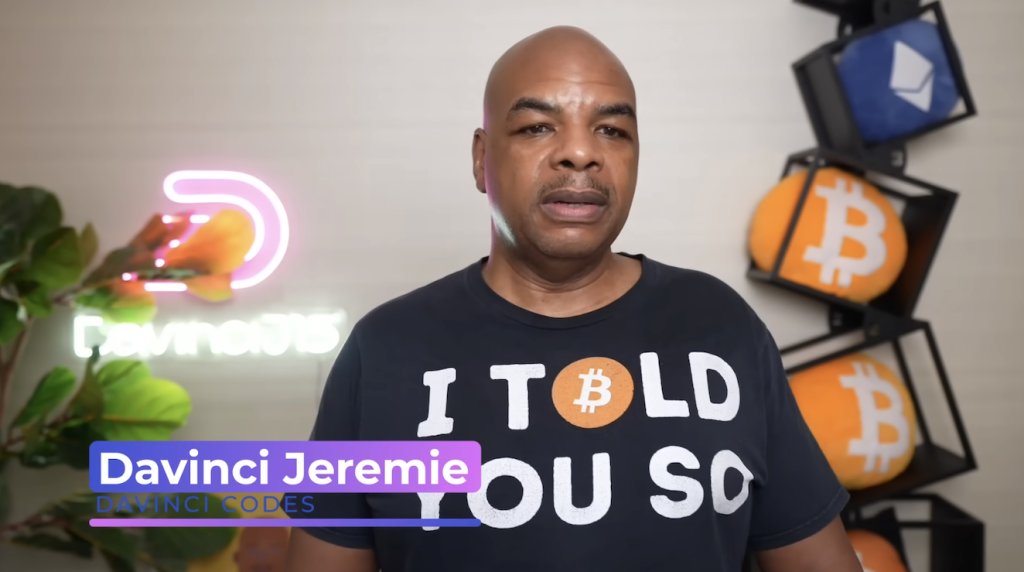
Davinci Jeremie constantly reminds his audience how he told them to buy Bitcoin many years ago. (Davinci Jeremie) “It’s not what most people would think,” he adds.
Jeremie is one of Bitcoin’s earliest YouTubers and built a channel with more than 926,000 subscribers and over 2,600 videos, most of which focus on Bitcoin.
He is also well known for publicly urging others to buy just $1 of Bitcoin when it was trading at $100 in 2013.
Read also
His videos break down Bitcoin in a straightforward and accessible way, often tying it to problems he sees in the traditional financial system and the broader economy.
Jeremie admits he never enjoyed public speaking or appearing on camera, but says he pushed himself to do so as a modest contribution to expose what he describes as the “fraudulent scheme” of the current financial system.
His early Bitcoin advocacy was significantly recognized during the 2017 and 2021 crypto bull markets, when old clips of Jeremie urging viewers to buy $1 worth of Bitcoin resurfaced and went viral on social media, with captions highlighting him as the man who “told you to buy $1 of Bitcoin.”

In 2013, Davinci Jeremie released a video lasting over six minutes, urging viewers to purchase Bitcoin. (Davinci Jeremie) A YouTube video he published in May 2013, titled “Bitcoin update – just buy $1 worth of Bitcoin please,” has since garnered roughly 7.1 million views. People are still dropping comments on it today, some calling it a “hard spoiler,” and one even joking that he wishes he’d listened to Jeremie instead of buying a PlayStation.
Trading Bitcoin for Bitcoin mining equipment may not be worth it
Jeremie warns those who have profited from Bitcoin to think twice before spending their gains. “I guarantee you if you held Bitcoin, you’d probably have more,” he says.
He also warns against trying to game the system by selling Bitcoin in hopes of generating greater returns elsewhere in the Bitcoin industry, such as through mining.
Read also
“If you sold your Bitcoin to get mining equipment. Well, are you going to make money? Money? Yes. Are you going to make the same amount of Bitcoin? That’s debatable,” he says.
“That’s the key thing you have to remember. Whether it’s doing it with mining or doing it with other businesses, are you going to make as much value as Bitcoin can provide over time? Probably, the answer is probably not.”
Bitcoin may not see an uptrend in 2026, says Jeremie
Despite being one of the strongest public advocates for Bitcoin, Jeremie is not convinced that 2026 will be a good year for Bitcoin’s price. “Most likely, we’re going to go down,” he tells Magazine during an interview in December.
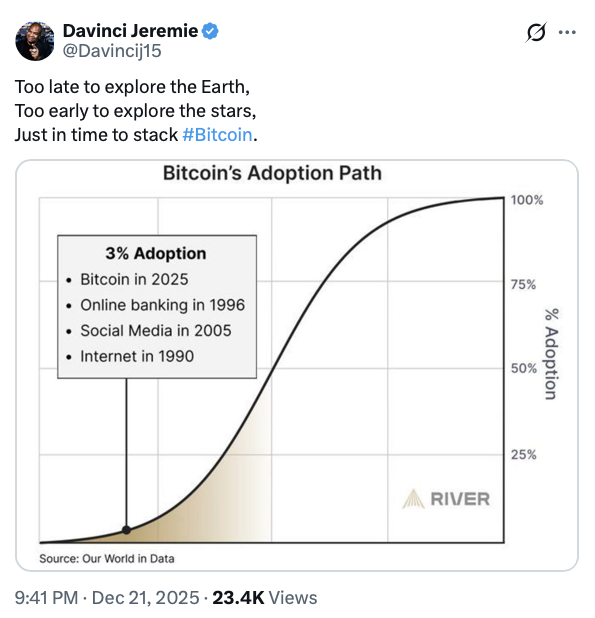
(Davinci Jeremie) “Best case scenario where we come back to the all-time highs. It’s a possibility,” he says.
A move back to Bitcoin’s peak of $125,100 from its current price of $91,455 would represent a gain of nearly 37%.
Jeremie’s bearish outlook comes as Bitcoin finished 2025 lower than where it began, defying bullish forecasts from Bitcoin advocates such as BitMine chair Tom Lee and BitMEX co-founder Arthur Hayes, who had tipped as high as $250,000.
Jeremie recently predicted that silver may even outperform Bitcoin in 2026. “It’s clear that the powers that be have lost control,” he said in a YouTube video.
He also said just months ago that an altcoin season “is not coming,” arguing that investors would be better off simply holding their Bitcoin.
“It might come in dollars, but not in Bitcoin,” he said in a recent YouTube video. “That means it’s best to save in Bitcoin,” he adds.
Subscribe
The most engaging reads in blockchain. Delivered once a week.


Source link - Earnings call transcript: Neogen Q2 2026 beats EPS expectations, stock surges
- Tariffs and low stocks propel aluminium costs to records for US consumers

- Earnings call transcript: Acuity Brands beats EPS forecast in Q1 2026
- Vara Mada project boosts Energy Fuels stock after strong feasibility results
- Nvidia’s Vera Rubin Keeps Crypto Networks Like Render in Demand

Computing powerhouse Nvidia’s Rubin platform can cut the cost of running advanced AI models, a claim that challenges crypto networks built to monetize scarce GPU compute.
Officially launched Monday at CES 2026, Rubin is Nvidia’s new computing architecture that improves the efficiency of training and running AI models. It is deployed as a system of six co-designed chips — branded under the Vera Rubin name in honor of the American astronomer Vera Florence Cooper Rubin — and is now in “full production,” Nvidia CEO Jensen Huang said.
For crypto projects built on the assumption that compute stays scarce, those gains can challenge the economics behind their models.
However, past improvements in computing efficiency have tended to increase demand rather than reduce it. Cheaper and more capable compute has repeatedly unlocked new workloads and use cases, pushing overall usage higher even as costs fell.
Some investors appear to be betting that dynamic still applies, with GPU-sharing tokens such as Render (RENDER), Akash (AKT) and Golem (GLM) rising more than 20% over the past week.
Most of Rubin’s efficiency gains are concentrated inside hyperscale data centers. That leaves blockchain-based compute networks competing in short-term jobs and workloads that fall outside the AI factories.

Render rose 67% in the first week of 2026 to lead the top 100 cryptos in gains. Source: CoinGecko Why Render benefits when compute gets cheaper
One modern example of efficiency expanding demand is cloud computing. Cheaper and more flexible access to compute through providers like Amazon Web Services lowered barriers for developers and companies, leading to an explosion of new workloads that ultimately consumed more compute.
That runs counter to the intuitive assumption that efficiency should reduce demand. If each task requires fewer resources, fewer servers or GPUs should be needed.
In computing, it rarely is. As costs fall, new users enter, existing users run more workloads, and entirely new applications become viable.
Related: Why crypto’s infrastructure hasn’t caught up with its ideals
In economics, this is known as the “Jevons Paradox,” as described by William Stanley Jevons in his 1865 book, “The Coal Question.” The English economist observed that improvements in coal efficiency didn’t lead to reduced fuel usage but more industrial consumption.

Jevon’s Paradox suggests that cheaper AI doesn’t automatically slash GPU demand. Source: Sketchplanations, CC BY-NC 4.0 Applied to crypto-based compute networks, consumer demand can shift toward short-term, flexible workloads that do not fit long-term hyperscale contracts.
In practice, that leaves networks like Render, Akash and Golem competing on flexibility. Their value lies in aggregating idle or underused GPUs and routing short-lived jobs to where capacity happens to be available, a model that benefits from rising demand but does not depend on controlling the most advanced hardware.
Render and Akash are decentralized GPU rendering platforms where users can rent GPU power for compute-intensive tasks like 3D rendering, visual effects or even AI training. They allow users to access GPU compute without committing to dedicated infrastructure or hyperscale pricing models. Golem, on the other hand, operates as a decentralized marketplace for unused GPU resources.

CES 2026 also showcased new technologies outside AI that can benefit from increased GPU access. Source: Render Network Decentralized GPU networks can deliver reliable performance for batch workloads, but they struggle to provide the predictability, tight synchronization and long-duration availability that hyperscalers are built to guarantee.
GPU scarcity expected throughout 2026
GPUs remain scarce because key components needed to build them are in short supply. High-bandwidth memory (HBM), a critical part of modern AI GPUs, is expected to be in shortage through at least 2026, according to components distributor Fusion Worldwide. Because HBM is required for training and running large AI models, shortages directly cap how many high-end GPUs can be shipped.

A business crippled by the ongoing chip shortage. Source: pcmasterrace/Reddit The constraint is coming from the very top of the semiconductor supply chain. SK Hynix and Micron, two of the world’s largest HBM producers, have both said their entire output for 2026 is already sold out, while Samsung has warned of double-digit price increases as demand outpaces supply.
Related: Bitcoin miners gambled on AI last year, and it paid off
Crypto miners were once blamed for driving GPU shortages, but today, the AI boom is pushing the supply chain into this state. Hyperscalers and AI labs are locking up multi-year allocations of memory, packaging and wafers to secure future capacity, leaving little slack elsewhere in the market.
That persistent scarcity is part of why decentralized compute markets can continue to exist. Render, Akash and Golem operate outside the hyperscale supply chain, aggregating underutilized GPUs and offering access on flexible, short-term terms.
They don’t solve supply shortages but provide alternative access for developers and workloads that cannot secure capacity inside tightly controlled AI data centers.
Bitcoin halvings push miners to AI
The AI boom is also reshaping the crypto mining industry, while Bitcoin (BTC) economics continues to change every four years due to halvings reducing block rewards.
Several miners are reassessing what their infrastructure is best suited for. Large mining sites built around access to power, cooling and physical space closely resemble the requirements of modern AI data centers. As hyperscalers lock up much of the available GPU supply, those assets are becoming increasingly valuable for AI and high-performance computing workloads.

Rising Bitcoin mining hash rate damages the bottom line of miners. Source: Blockchain.com That shift is already visible. In November, Bitfarms announced plans to convert part of its Washington State mining facility into an AI and high-performance computing site designed to support Nvidia’s Vera Rubin systems, while several rivals have pivoted to AI since the last halving.
Nvidia’s Vera Rubin does not eliminate scarcity but makes hardware more productive inside hyperscale data centers, where access to GPUs, memory and networking is already tightly controlled. The supply constraints, particularly around HBM, are expected to remain throughout the year.
For crypto, GPU scarcity creates space for decentralized compute networks to fill gaps in the market, serving workloads that cannot secure long-term contracts or dedicated capacity inside AI factories. These networks are not substitutes for hyperscale infrastructure but function as alternatives for short-term jobs and flexible compute access during the AI boom.
Magazine: Bitget’s Gracy Chen is looking for ‘entrepreneurs, not wantrepreneurs’
Source link - CorMedix stock falls after issuing 2026 revenue guidance
- Merck upgraded on post-Keytruda growth, AbbVie cut as upside baked in – Wolfe
- China’s Interest-Bearing Digital Yuan Piles Pressure on US Stablecoin Rules

China’s move to let banks pay interest on digital yuan wallets from Jan. 1 is sharpening the debate in Washington over whether United States dollar stablecoins are being left structurally uncompetitive by the Guiding and Establishing National Innovation for US Stablecoins (GENIUS) Act’s ban on yield.
The change allows commercial banks to pay interest on balances held in e‑CNY wallets, with Chinese officials framing it as a way to better integrate the central bank digital currency (CBDC) into bank balance sheets.
Coinbase CEO Brian Armstrong warned in an X post on Jan. 7 that the decision gives China a “competitive advantage” over US dollar stablecoins and has a “big impact on whether US stablecoins are competitive.”

US stablecoins are being left “uncompetitive.” Source: Brian Armstrong Armstrong’s latest comments build on a broader warning he has delivered to lawmakers over the past year. In April 2025, he argued that Congress should allow regulated stablecoin firms to pay users interest, stating that bans on yield would push innovation offshore.
Related: China to let banks pay interest on digital yuan wallets from January 2026
GENIUS Act, bank lobby, and the “rewards” fight
The GENIUS Act, signed into law in July 2025, created a federal framework for dollar‑pegged stablecoins but included a clause that prevents issuers from paying “any form of interest or yield.”
Banks have since lobbied to widen that ban to third‑party platforms, warning that stablecoin rewards could siphon deposits away from the traditional banking system, particularly smaller lenders.
Crypto executives and industry groups have pushed back, warning that banning third‑party stablecoin yields would entrench banks, weaken US dollar competitiveness, and hand an advantage to China’s interest‑bearing digital yuan.
New stablecoin designs in a weaker-dollar world
This policy backdrop is colliding with a shifting macro environment and new stablecoin designs.
Ron Tarter, CEO of MNEE, a US dollar-backed stablecoin issuer, told Cointelegraph that a weaker dollar in 2026 could prompt US lawmakers to view dollar‑denominated stablecoins as “strategic tools to preserve dollar hegemony in global commerce.”
He said it could potentially accelerate regulatory clarity for compliant US dollar stablecoins, while “more experimental designs” such as algorithmic stablecoins and “stablecoins that aren’t backed by US dollars,” might face higher barriers.
Reeve Collins, cofounder of Tether and chairman of STBL, the entity behind the USST stablecoin, said the value proposition of stablecoins had already shifted from pure access and speed to preserving purchasing power and “beating inflation.”
He told Cointelegraph, “That naturally drives demand toward new designs, including stablecoins backed by real-world assets and structures that share yield with users rather than concentrating it with the issuer.”
Related: How crypto laws changed in 2025 — and how they’ll change in 2026
Midterms and enforcement risks
Looking into politics and the likelihood of a weak performance of the Republicans in the 2026 midterms, Drew Hinkes, a partner with Winston & Strawn law firm, weighed in on how that may affect crypto policy.
He argued that an outright repeal of the GENIUS Act after the 2026 midterms was “highly unlikely,” but warned that a change in control of Congress could slow or block a broader market structure bill and reshape regulatory enforcement.
When asked how stablecoin issuers should think about legal and regulatory risk in that environment, Hinkes noted that digital asset firms “have always existed in an environment of regulatory uncertainty,” but that a change in control of Congress was “unlikely to materially impact stablecoin issuers.”
Tarter, a former lawyer, said that crypto companies “should operate on the assumption that the GENIUS Act will remain in place, and the Clarity Act will pass before the midterms.”
However, they should “document their compliance rigorously,” as any shift to a more aggressive Securities and Exchange Commission (SEC) or Commodity Futures Trading Commission (CFTC) could tighten the screws on US stablecoins just as China steps up its own digital money experiment.
Source link - Simply Good Foods earnings beat by $0.03, revenue topped estimates
- Bank of America upgrades Coinbase as it aims to become the ‘everything exchange’

- Neogen earnings beat by $0.07, revenue topped estimates
- American Electric Power signs $2.65 billion deal for fuel cells

- Lindsay shares dip as revenue falls short of expectations
- New York’s Cooper Union settles campus antisemitism case, pledges reforms

- Florida Revives Bitcoin Crypto Reserve Bill After Earlier Pushback

Florida lawmakers are advancing a proposal that would allow the state to create a strategic cryptocurrency reserve, narrowing earlier efforts to a framework that would effectively limit holdings to bitcoin.
According to Florida’s legislative records, Senate Bill (SB) 1038, sponsored by Republican Senator Joe Gruters, was filed on Dec. 30 and was referred to the Appropriations Committee on Agriculture, Environment, and General Government on Wednesday, where it must clear hearings and votes before advancing to the Senate floor.
The bill would establish a Florida Strategic Cryptocurrency Reserve, managed by the state’s chief financial officer (CFO), which would allow the office to purchase, hold, manage, and liquidate cryptocurrency under a standard similar to those governing public trust assets.
While the legislation does not explicitly name Bitcoin (BTC), it restricts eligible purchases to crypto that maintained an average market cap of at least $500 billion in the last two years, a threshold that only Bitcoin meets.

US State Reserve Race chart. Source: Bitcoin Laws A Senate-led attempt after broader efforts stalled
The new Senate proposal follows and significantly diverges from Florida’s earlier attempts to authorize state-level crypto investments.
On Oct. 17, 2025, Republican Party Representative Webster Barnaby filed House Bill (HB) 183, which sought to allow the state and certain public entities to invest up to 10% of their funds in a broad range of digital assets, including Bitcoin, crypto exchange-traded products (ETPs), crypto securities, non-fungible tokens (NFTs), and other blockchain-based products.
HB 183 was a revised version of HB 487, which was withdrawn in June after failing to advance out of a House operations subcommittee. While Barnaby’s revised proposal added stricter custody, documentation, and fiduciary standards, the broad asset scope and potential exposure of pension and trust funds faced pushback from lawmakers.
By contrast, SB 1038 removes pension and retirement funds entirely and places oversight directly under the CFO through a standalone reserve structure.
Its market-cap eligibility rule mirrors approaches adopted in states like New Hampshire and Texas, both of which have enacted more narrowly defined Bitcoin reserve frameworks in 2025.
Related: Bitcoin faces ’boring sideways’ grind in coming months: CryptoQuant CEO
What’s next in the legislative process?
SB 1038 is contingent on a companion legislation establishing the necessary trust-fund mechanics for the reserve. This means it cannot take effect unless related bills are also enacted during the same legislative session.
A House companion measure, HB 1039, was also filed, signaling coordinated Senate and House backing.
If the legislation advances, the CFO would be mandated to submit reports to legislative leaders starting in December 2026, detailing the reserve’s holdings, value, and management actions.
Whether the proposal advances will depend on whether lawmakers view the narrower, bitcoin-focused structure as sufficiently distinct from earlier efforts that failed to gain traction.
Magazine: Big questions: Would Bitcoin survive a 10-year power outage?
Source link - Helen of Troy shares tumble nearly 10% as tariffs weigh on profit outlook
- French farmers block Paris streets in protest against Mercosur trade deal

- RPM International shares fall over 5% as earnings miss expectations
- Gap shares can rally more than 50% as Athleta sales improve, says UBS

- Neogen stock soars 20% as earnings beat drives investor optimism
- Stocks making the biggest moves premarket: LMT, NOC, GAP, AA

- Nestlé stock dips after China urges recall of baby formula
- Banks Must Upgrade Their Blockchain Infrastructure


Opinion by: Igor Mandrigin, co-founder and chief technology and product officer of Gateway.fm
For years, private distributed ledger systems, like Hyperledger, have provided banks with a secure means to explore blockchain technology without venturing into public networks. These frameworks delivered privacy, permissioned access and a sense of institutional control — qualities that undoubtedly appealed to traditional finance players when the crypto market was still viewed as the Wild West.
The environment has changed fundamentally since then, as tokenized assets, stablecoin settlements and institutional crypto exposure have quickly become the standard. The closed, permissioned models that once spoke to the risk-averse tendencies of banks now hold them back. At this critical geopolitical and macroeconomic juncture, financial institutions need to move beyond legacy frameworks and adopt public, permissioned layer 2 infrastructure built with zero-knowledge (ZK) proofs.
The rationale is straightforward. These newer systems maintain the privacy and compliance standards regulators demand, but they also offer the interoperability and scalability that modern finance requires.
Some readers, especially those in regulatory or enterprise IT roles, might bristle at this contention, possibly arguing that public chains are too volatile, too transparent or too “ungovernable” to meet enterprise standards. Others may argue that traditional distributed ledger technology (DLT) is already effective and that migrating would create unnecessary operational and compliance risks. This dated view underestimates how rapidly global finance is moving onchain and how expensive it will be for institutions to remain isolated in closed systems.
The shift from control to connectivity
A decade ago, blockchain adoption was primarily about control. Enterprises wanted distributed systems, but only within walled gardens could they manage internally. That made sense when public blockchains were slow, expensive and lacked privacy. In that environment, Hyperledger and its peers offered predictability, vetted participants and centralized governance and were able to satisfy auditors without revealing transaction data to the world.
Today’s financial landscape is radically different. Tokenized money markets are scaling up to billions in daily transaction volume, while stablecoins are being integrated into global settlement systems at a rapid rate. Layer 2 solutions are bringing low-cost, high-speed, privacy-enhanced functionality to public chains. ZK technology now makes it possible to prove compliance or creditworthiness without revealing sensitive data.
The trade-off between privacy and openness that once justified private blockchains has dissolved.
Isolation is now a liability
The danger isn’t that private blockchains will fail technically. The danger is that they’ll fail strategically. Ultimately, legacy DLT stacks were never built for cross-chain communication, global liquidity, or real-time asset settlement. They operate as digital islands, disconnected from the growing onchain ecosystem where tokenized assets, collateralized lending and instant settlement are converging.
Related: JPMorgan sees advantages in deposit tokens over stablecoins for commercial bank blockchains
That isolation comes at a cost. Liquidity is increasingly aggregating on public infrastructure, where decentralized finance (DeFi) protocols, tokenized treasuries and institutional stablecoin markets interact seamlessly. A private network, no matter how compliant, can’t tap into that liquidity. It can only watch it move elsewhere.
The longer banks wait to connect to open, interoperable infrastructure, the harder it becomes to catch up. Institutions that build on closed systems risk becoming like legacy clearinghouses in an era of automated settlement.
The case for public, permissioned L2s
Thankfully, the right middle ground already exists. Public, permissioned layer 2 networks — enhanced with zero-knowledge cryptography — enable financial institutions to retain privacy and control while operating within a composable, open ecosystem.
This can help with selective disclosure, where banks can demonstrate regulatory compliance, like Anti-Money Laundering (AML) and Know Your Customer (KYC) checks, using ZK-proofs, without revealing transaction data to the public. Layer 2s built on Ethereum or similar base layers can directly connect with stablecoin issuers, tokenized money markets and real-world asset protocols.
This doesn’t require banks to sacrifice their security posture. It simply allows them to build within the same ecosystem as everyone else, using infrastructure that scales, communicates and settles in real time.
SWIFT has begun testing an onchain version of its global messaging infrastructure using Linea, an Ethereum layer 2 network. This signals to banks that, if the backbone of global interbank communication is moving toward blockchain integration, traditional institutions can’t ignore it.
Lessons from the market
We’re already seeing the gap widen between institutions that embrace open infrastructure and those that don’t. Payment networks like Visa and Stripe are experimenting with stablecoin settlements on public chains. Meanwhile, tokenized US treasuries and institutional DeFi protocols are attracting capital from hedge funds and asset managers who want yield onchain, not in permissioned silos.
This convergence of tokenized finance is becoming the new standard for capital markets, and banks that rely on outdated DLT models risk losing their role as intermediaries in this next generation of settlement infrastructure. Conversely, those that transition to public L2s can become the new gateways for programmable, composable financial services.
If large financial institutions begin building on open, ZK-powered layer 2s, the impact would be profound. Liquidity would consolidate across networks, improving efficiency and reducing friction between traditional and crypto-native markets. Tokenized assets could flow seamlessly between institutions, driving adoption of onchain treasuries, credit markets and consumer payments.
For crypto markets, this shift would bring legitimacy and volume from traditional finance. For banks, it would unlock new fee structures and business models, including custody, compliance-as-a-service and programmable deposits while reducing settlement costs and counterparty risks.
The opposite scenario is also clear: Banks that refuse to evolve will find themselves operating on isolated rails, unable to interact with global liquidity. They’ll become spectators to a financial ecosystem that’s increasingly open and programmable.
Moving from private to public infrastructure will not be easy. It will require new security models, updated compliance frameworks and a willingness to collaborate with regulators and technologists. Clinging to systems that can’t scale or interoperate is far riskier.
Modernization and compliance do not have to be a zero sum game. lnstitutions don’t need to abandon privacy or compliance to make progress in this new direction. What they need to leave is the assumption that “private” equals “safer.”
In the new era of tokenized finance, isolation is the real threat.
Opinion by: Igor Mandrigin, co-founder and chief technology and product officer of Gateway.fm.
This opinion article presents the contributor’s expert view and it may not reflect the views of Cointelegraph.com. This content has undergone editorial review to ensure clarity and relevance, Cointelegraph remains committed to transparent reporting and upholding the highest standards of journalism. Readers are encouraged to conduct their own research before taking any actions related to the company.
This opinion article presents the contributor’s expert view and it may not reflect the views of Cointelegraph.com. This content has undergone editorial review to ensure clarity and relevance, Cointelegraph remains committed to transparent reporting and upholding the highest standards of journalism. Readers are encouraged to conduct their own research before taking any actions related to the company.
Source link - Commercial Metals rises over 2% on strong Q1 earnings beat, revenue growth
- Soho House shares drop as MCR Hospitality unable to fund $200m deal
- Binance Debuts Gold, Silver Perps, USDT TradFi Settlement Stablecoin

Binance has launched new perpetual futures contracts tied to gold and silver, expanding the crypto exchange’s derivatives offering beyond digital assets as demand grows for exposure to traditional safe-haven markets.
Binance said Thursday it has introduced gold and silver perpetual futures that allow investors to trade the metals around the clock without an expiration date.
The contracts are settled in Tether’s USDt (USDT) stablecoin, giving traders onchain access to price movements in precious metals rather than direct ownership of the underlying assets.
The new products, listed as XAUUSDT and XAGUSDT, are designed to track the price of gold and silver and are aimed at bridging traditional financial markets with crypto trading infrastructure, Binance said in a statement. The exchange added that more traditional asset-linked contracts are planned.
Binance’s perpetual contracts are regulated by the Financial Services Regulatory Authority (FSRA) with licenses obtained under the Abu Dhabi Global Market (ADGM) framework, through Next Exchange Limited, a Binance entity.
The new contracts are a “key step in bridging traditional finance and crypto innovation,” backed by “strong regulatory compliance and trust,” said Jeff Li, vice president of product at Binance.
Other exchanges offering precious metals-tied perpetual contracts include Coinbase, MEXC, BTCC, BingX, and Bybit, with the latter only offering perpetual gold contracts.
Gold and silver rise to new all-time highs on growing safe-haven demand
Binance’s offering follows a period of strong demand for the world’s leading precious metals, which both logged new all-time highs.
Geopolitical tensions and a weakening US dollar drove gold and silver to new all-time highs in December as gold’s price peaked above $4,549 per ounce on Dec. 26, while silver reached $83 per ounce on Dec. 28, according to data from goldprice.org.
Related: Morgan Stanley adds Ethereum staking ETF filing to growing crypto lineup
Both precious metals outperformed Bitcoin over the past year, which declined by around 5%. Gold rose 67% while silver rallied 152% during 2025. Gold traded at $4,424 per ounce while silver changed hands above $75.60 at the time of writing.

BTC, Gold, Silver, 1-year chart. Source: goldprice.org Tokenized commodities also surged to new all-time highs in December, following the wider rally in precious metals.
Related: BitMine buys $105M Ether to kick off 2026, still holds $915M in cash
Binance’s decision to settle the contracts in USDT comes as Tether continues to expand its presence. The company has opted not to seek authorization under the European Union’s Markets in Crypto-Assets framework, citing concerns over how the rules apply to stablecoins. At the same time, USDT has gained regulatory recognition in some jurisdictions, including Abu Dhabi, where it has been approved for use by regulated firms.
Cointelegraph reached out to Binance to clarify the jurisdictional availability of the contracts, including whether they will be offered to users in the European Economic Area or the United Kingdom, but did not receive a response by publication time.
Magazine: Will Robinhood’s tokenized stocks REALLY take over the world? Pros and cons
Source link - Simply Good Foods beats Q1 estimates, reaffirms 2026 outlook
- JPMorgan downgrades Alcoa following strong run, sees aluminum pricing ‘leveling out’

- Zalando shares fall as company announces closure of German fulfillment center
- Alphabet is coming off a strong year. One analyst sees even more upside for the Google parent

- Morning Bid: Trump’s visible hand

- Acuity Brands earnings beat by $0.11, revenue was in line with estimates
- UBS upgrades BNP Paribas, citing 32% sector discount; stock up
- Acuity Brands beats Q1 earnings estimates as sales rise 20%
- AB Foods cuts profit forecast on Primark discounting, US weakness

- Cubans brace for more hardship as US pressure on Venezuela chokes off oil