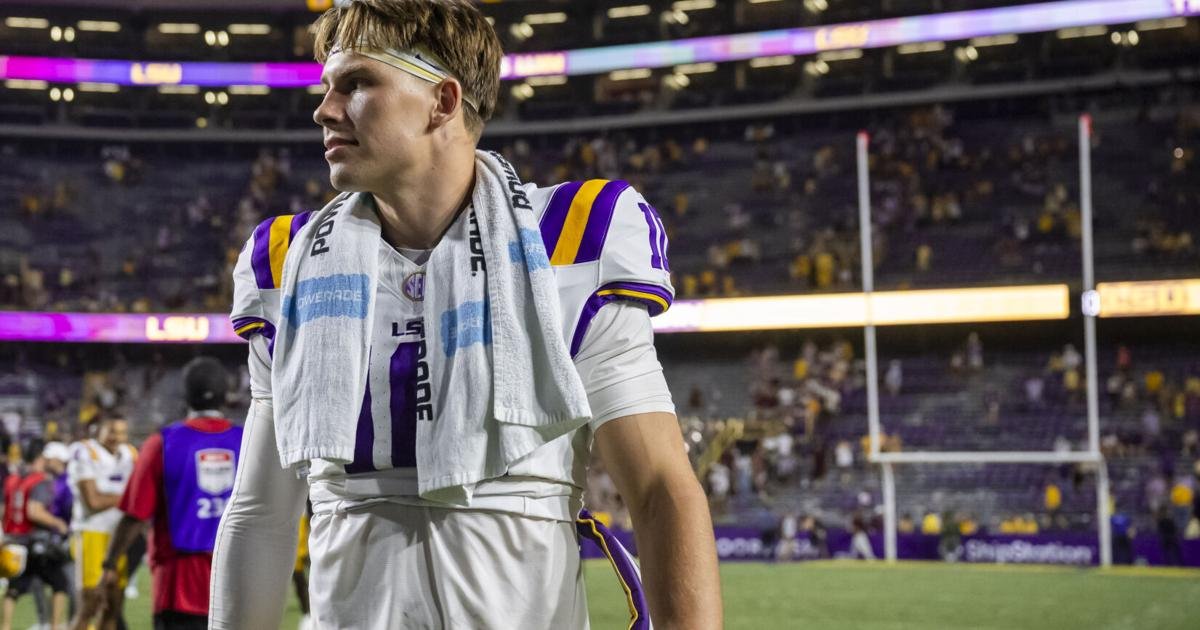
Dallin Leavitt never let his little brother win.
A lack of mercy equipped Dallin as a bulldozing BYU and Utah State safety who scratched out a half-dozen seasons in NFL. Sam Leavitt, who was 10 years Dallin’s younger, had to develop a cleverness and competitiveness to achieve what his brother wouldn’t allow.
Case in point: 12-year-old Sam’s propensity for shooting, and swishing, jumpers from just inside the midcourt line when they matched up 1-on-1 on the hardwood.
“I had to, I wouldn’t say cheat,” Dallin said, “but, back in the day, I would say, ‘I’m not gonna just back you down and big-body you.’ We got to a game, I think he was up, like, 7-2, and I’m like, ‘Bro, forget all these rules.’”
There have been times in Sam’s athletic career where he absorbed punishment to pursue victory, including what his older brother forced upon him to squeak out a win.
When he quarterbacked Arizona State in 2024, Leavitt fractured ribs and punctured a lung in a Week 4 game against Utah. The next year, a lisfranc bone gave out in Week 4 versus Baylor. This year, the LSU signal caller pulled a hamstring Week 4 versus Texas A&M.
He led the Sun Devils to a Big 12 title and the College Football Playoff after the punctured lung. He transferred after the broken foot, but Leavitt is figuring out how to play true “point guard” in LSU’s offense after he was literally hamstrung as a scrambler.
He’s clever. He’s competitive. He’s the annoyingly successful little brother who found ways to adapt and win, even if there were some tumbles along the way.
Leavitt, who threw eight interceptions in his first six games at LSU, just notched his first turnover-less game against Mississippi State, dissecting the Bulldogs with quick throws on his way to 31-of-38 passing, 289 yards and four touchdowns.
He’s now the SEC’s passing yardage leader through seven games with 1,785.
“Every single week we’ve just gotten better,” Leavitt said. “We keep playing cleaner ball, understanding just how this offense works.”
The aspirations of a two-loss LSU squad, needing a rally to make the playoff, rest upon the shoulders of a little brother who lost a lot growing up.
He’s winning now.
Finding his edge
Dallin isn’t sure he has lost to his little brother in 1-on-1 more than a couple of times, but they stopped playing once Dallin was a pro and Sam was a budding recruit. They were both so intense, if they went against each other, they’d risk a full-blown fight.
When 22-year-old Dallin refused to play again after his rally from 7-2 down, because he was exhausted, 12-year-old Sam egged him on: “You’re soft. Play again.”
“I would beat him by 40 (in Madden) and he’d cry and he’d throw the controller and storm off and I’d be like, ‘Oh, you’re going to quit? Okay, I’m going to turn off the game,’” Dallin said. “He’d be like, ‘No, I’m running it back.’
“It’s just his nature. He loves to play, and he wants to compete.”
This was inevitable because of the family Leavitt was born into. His dad, Jared, was a linebacker at BYU. His mother, Tania, was a trainer at gyms who had her kids running through agility ladders and over hurdles.
Because he was many years younger than his siblings, Sam started at an earlier age.
“He would hang out with them,” Tania said, “and think he could compete with them.”
Competing wasn’t always fun, because Tania was unbeatable in Boggle. There was a game called “Cover Your Assets” that drove Sam into a tizzy if family members started stealing his cards. If he lost in Bananagrams, Sam would scramble the tiles, throw them off the table and then storm upstairs.
He was smart, though, and very determined. He decided he’d be an NFL quarterback and placed a whiteboard in his bedroom growing up, asking “How great do you want to be?” He’d set an alarm for 7 p.m. each day and perform his shoulder mobility exercises.
Sam also followed Dallin to train at Ryan Paul’s gym in Washington, more than an hour from their home in Oregon.
“Dallin was more just, I’m brute, I’m gonna run through you,” Paul said. “Sam, because of how fluid he is, how efficient he is as a mover, I can run through you, but why would I do that? I’d rather make you look like a fool by running around you and juking you.”
He has since collected a long list of advantage-seeking measures, which were displayed during an ESPN broadcast this season.
Sam sleeps 9.5-10 hours a day. He throws on blue-light glasses one hour before bed. He eats organic food and uses an EQ Flux, a bioelectric therapy device, for a “full body flush.”
“I always preach about the parasympathetic state,” Leavitt told attendees at LSU’s women’s clinic this summer. “You can’t recover if you’re in ‘fight or flight.’ So all my machines are doing that. And then you kind of have to learn how these different machines work, the way that energy works — alpha, beta, delta, all those different things.”
He’s part quarterback, part mad scientist, trying to crack a competitive code.
As a kid, Sam would ask his defensive-minded brother questions, wanting to understand his opponents’ weak points. Dallin wouldn’t say his brother’s natural gift was as much Xs and Os as much as his innate ability to recognize open space.
If the two brothers played 1-on-1 on the hardwood, Dallin was winning every time because of his physical advantages. If they split off in a 5-on-5 pickup game, it didn’t matter if Sam had the worst teammates and Dallin had the best. Sam, the sharpshooter who could thread passes through undefended space, won every time.
“Like, his awareness is insane,” Dallin said.
Big brother, a practice squad player for the Raiders, once asked franchise quarterback Derek Carr to swing by a park to watch his little brother throw a football around.
Carr ended up spending an hour with the 14-year-old Leavitt, who asked mature questions about how to attack one coverage or another.
“He had a really good understanding of what Derek was saying, and he could really have conversation about it,” Dallin said. “Obviously he was impressed with his arm, but that’s not always the most important thing. It’s really like the cerebral side of playing quarterback that Derek, No. 1, really values.”
In the danger zone
Sam spans the competitive spectrum. He can be risky, like all football players to some certain extent, but he’s even had Dallin concerned at times. He was in Arizona State’s locker room at halftime after Sam punctured a lung versus Utah.
“He was cramping, and we thought that it was just a spasm, like where he got hit in the ribs or whatever,” Dallin said.
Really, his body wasn’t getting enough oxygen.
He returned for the second half, and would “thug it,” Dallin said, to win the game.
Everybody saw the Leavitt brothers celebrating with physicality after a Big 12 title was won months later, red in the face as they pushed, shoved and slapped each other’s hands. There was an appreciation for what had been on the line.
“You puncture a lung, you can die, right?” Dallin said, referencing that Utah game. “I don’t think people really give him the credit for how tough he is physically, and then also mentally, to say like, I’m in that place.”
“So it was just a long season that led up to that point,” Dallin said of their Big 12 title celebration, “where for me, it was just like ‘Holy crap, bro, I can’t believe you did what you just did this year’ coming off of a team that was 3-9.”
Knowing just how much Sam has sacrificed, Dallin was frustrated when Arizona State fans questioned Sam’s toughness after he was shut down in favor of foot surgery and transferred to LSU. Sam hadn’t been healthy all season.
His foot was officially injured in Week 4 versus Baylor, but he played in three more games. Dallin begged Sam to sideline himself during a loss to Houston that was ultimately his last game in a Sun Devil uniform.
“He’s like, ‘No, we gotta win this game. What are you talking about? Get out of my face,’” Dallin recalled. “Like, he was mad at me for asking him to not go back in.”
LSU coach Lane Kiffin knew there was no way Leavitt was coming out of the Texas A&M contest this year, merely because he pulled a hamstring and couldn’t scramble.
It was maybe the best thing that could happen, in Kiffin’s view, because Leavitt couldn’t do too much if he couldn’t freelance with his legs. The injury literally forced his quarterback to stay in the pocket, get the ball out quickly and fulfill his mission.
Both the competitive and cerebral sides of Leavitt brought him to LSU. There was “synergy,” Dallin said, between the families of Leavitt and Jaxson Dart, who endorsed Kiffin, offensive coordinator Charlie Weis Jr. and quarterback coach Dane Stevens.
They have proven themselves expert at scheming space for quarterbacks to exploit. Going into the season, Dallin heard positive reviews from his brother, who isn’t so little anymore at 6-foot-2, 207 pounds. He stands taller than Dallin, who is 5-10, 195.
“Sam feels like they’ve done a great job of hearing him and implementing pieces that he likes and he feels comfortable with,” Dallin said.
The progression
It was going to take Leavitt time to learn LSU’s system — there are countless adjustments and route combinations to counter a defense — but he’s completed 77 percent of his passes in his last four games after hitting 61 percent in his first three.
According to Pro Football Focus, Leavitt was releasing his throws in an average of 3.06 seconds in those first three games; his time to target is 2.55 seconds in four games since, which is a stark difference in processing time.
Leavitt is connecting with his receivers, on and off the field. Jackson Harris, the transfer from Hawaii, will come over to Leavitt’s house to partake in his recovery equipment, which Harris barely understands.
“I just trust him and I want to get better, and he does everything he can to get better,” Harris said. “I can’t go into the details. I really don’t know, to be honest. But it’s good stuff.”
At base, that’s all LSU wants to see. Leavitt has gotten better, week by week.
Dallin has watched his little brother grow over 21 years, from a kid who couldn’t stand losing at Bananagrams to playing the second half of a football game with an injured lung.
Sam still has his whiteboard. It’s transformed from merely listing big-picture goals about “How great do you want to be?” to also including process-driven reminders on how much film he needs to watch or how many hours to train in LSU’s virtual reality system.
He hasn’t erased the big-picture goals completely.
“Go win a national championship, go win the Heisman,” Dallin said. “If you’re a great player in college football, those are your goals, right? But I think on ‘How do you get there’ is really what’s changed. He’s really looking at the intricacies of how to be the best player.”
It’s process over outcome. It’s still taking shots when they come open, like the 12-year-old who would pull up from just past the midcourt line, but closer to the basket, per se, hitting running back Dilin Jones on a swing pass or Harris cutting across the middle.
“I felt like I played a pretty easy game, just getting the ball out to my guys and having them go make plays,” Leavitt said after a 31-0 win over Mississippi State. “I’m continuing to develop and learn from Coach Weis, Dane and Kiffin … what’s four-down territory, when do you gotta take shots versus control the tempo, push the pace, all those things.
“It’s just a constant progression. They do a great job getting me ready every single week.”
#LSU #Sam #Leavitt #finding #edge #Lane #Kiffins #scheme #LSU
Source link