





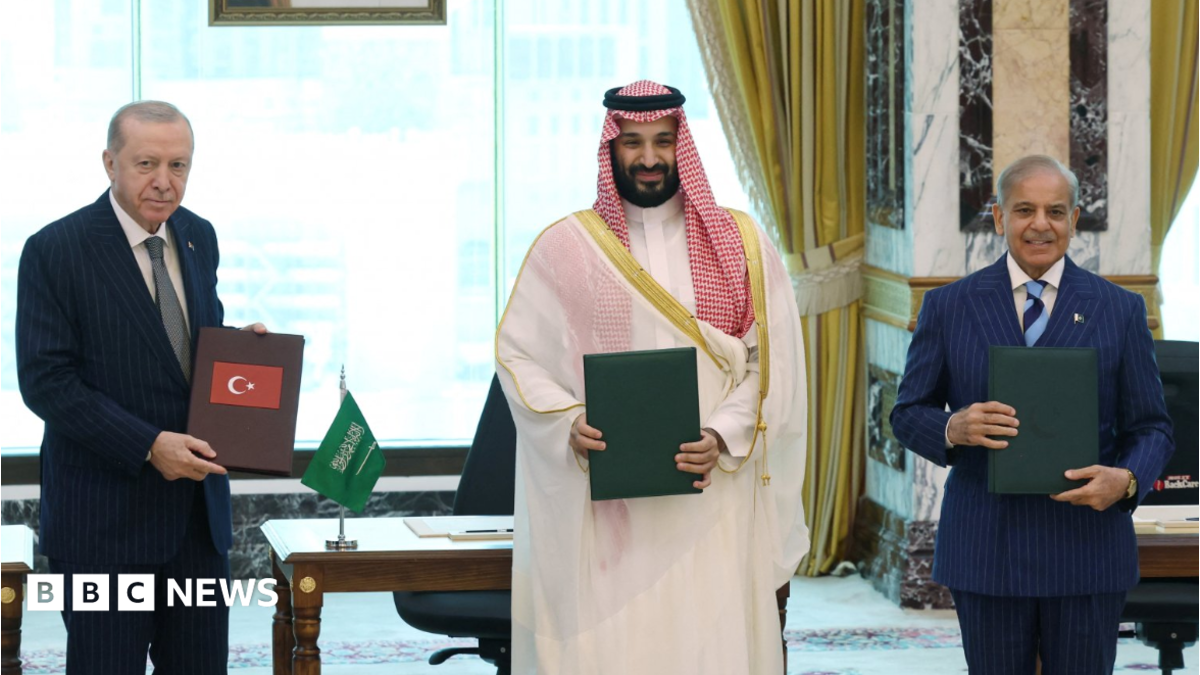
Saudi Arabia, Turkey and Pakistan sign defence agreement
BBC News
Saudi Arabia, Turkey and Pakistan have signed a joint defence agreement, saying an attack on one of them would be seen as an attack on all three.
The pact was announced at a meeting between Saudi Crown Prince Mohammed bin Salman, Turkish President Recep Tayyip Erdogan and Pakistani Prime Minister Shehbaz Sharif in the Saudi city of Mecca.
The three countries have been looking to strengthen security ties as the war between the US and Iran has drawn in Saudi Arabia and disrupted maritime traffic through the Strait of Hormuz, a crucial oil shipping channel, and the Red Sea.
Saudi Arabia and Pakistan had already announced a joint defence pact last year.
The new Mecca Joint Defence Agreement aims “to strengthen collective deterrence against any act of aggression, and stipulates that any armed attack against any one of the three States shall be regarded as an attack against them all”, a statement reads.
“It further provides for the enhancement of all aspects of defence co-operation among the three States.”
Although the pact pledges mutual support between the three Sunni Muslim states, it provides no specifics on the obligations of each.
A Turkish official quoted by Reuters news agency said the pact was “purely defensive in nature”.
In this defence relationship, Saudi Arabia brings the financial power and is one of the largest weapons purchasers. Turkey is the second-largest military force in Nato, with an advanced defence production capacity, while Pakistan has nuclear weapons.
The three countries have expressed concern as the conflict in Iran shows no sign of abating, and the US struggles to contain regional repercussions.
After the US and Israel attacked Shia Islam-dominated Iran on 28 February, Iran and its allies have launched attacks on targets in Saudi Arabia and other Gulf states and blockaded their shipments.
Pakistan has acted as an intermediary between Iran and the US and hosted ceasefire negotiations, leading to a temporary stop in military operations, but fighting flared up again.
Saudi Arabia has largely tried to stay out of the conflict, but, after being attacked from three sides, carried out joint strikes last month with the US on Iranian proxy militias in Iraq who they believe were launching drones at the Kingdom.
In Yemen, the Iran-backed Houthi rebels – who control much of the north-west of the country – have been fighting government forces, which are backed by a Saudi-led coalition.
Last month the Houthis announced a “maritime embargo” against Saudi Arabia and targeted Saudi airports, oil facilities and tankers in the Red Sea.
Saudi Arabia has responded with strikes targeting Houthi positions and by forming a new naval coalition to protect shipping in the Red Sea and the Gulf of Aden.
#Saudi #Arabia #Turkey #Pakistan #sign #defence #agreement,
Source link