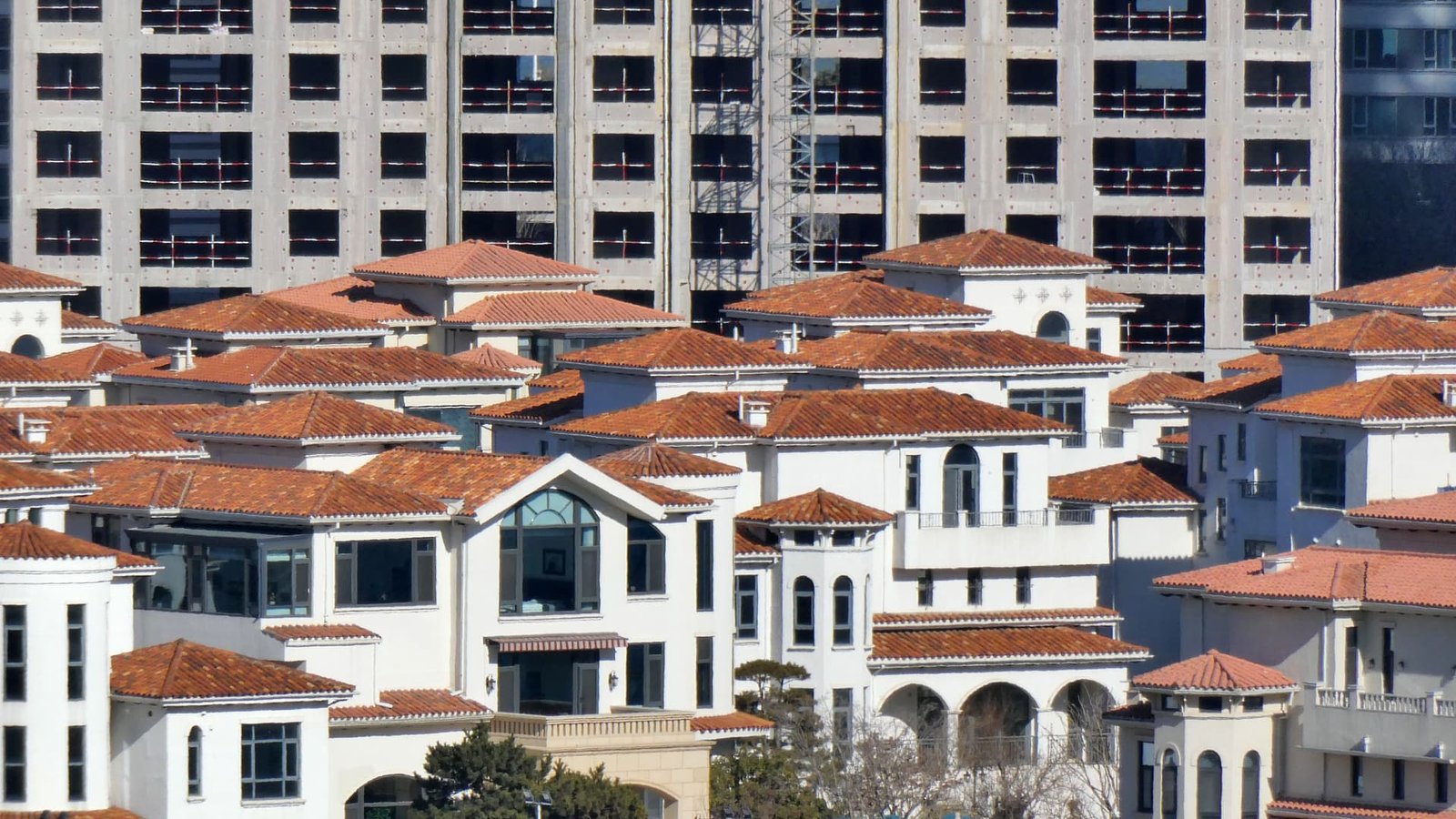
Real Estate Projects in Yantai, Shandong, China on January 5, 2026.
Cfoto | Future Publishing | Getty Images
BEIJING — Chinese policymakers may be finally warming to the idea of tackling the country’s worsening real estate slump, raising expectations that stronger support measures could be coming later this year.
The Communist Party’s official journal Qiushi, which means “seeking truth,” kicked off 2026 with a Jan. 1 article calling for “more powerful and precise measures” to stabilize property market expectations.
Since then, the Hang Seng China A Properties Index, which includes developers Vanke and Seazen, has climbed more than 6% to start the year, reflecting growing investor optimism.
The Qiushi commentary was notable for its scope, said Ting Lu, chief China economist at Nomura.
“This is the most comprehensive assessment of China’s property markets published in Qiushi since the sector’s collapse in mid-2021,” Ting said in a report earlier this week. “Its significance should not be overlooked.”
Public Chinese official commentary, such as Qiushi articles, is closely watched because it often signals internal policy debates and potential shifts in official thinking before decisions are announced.
The article appeared ahead of China’s annual parliamentary meeting in March, when top leaders gather to set policy goals for the year ahead. This year, the meeting will also release full details on its next five-year development plan.
“Beijing cannot afford to let its property sector slide indefinitely, and much more decisive action is needed to truly stabilize the property sector and the overall economy,” Lu said.
“Given rising trade tensions and the likely unsustainable strength in the export sector, Beijing might eventually be compelled to ramp up its policy measures significantly.”
China’s property downturn has dragged on despite a clear call from top leaders in Sept. 2024 to halt the sector’s decline. New home sales have nearly halved since Beijing started cracking down on developers’ heavy reliance on debt for growth, with floor space sold in 2025 falling to levels seen back in 2009, according to a report this week by the China Real Estate Information Corp.

Measures introduced so far have focused on easing some restrictions on buyers, originally intended to stem speculation.
The Qiushi article called for property policies to be implemented “in one go,” rather than a “piecemeal approach.”
Cliff Zhao, chief economist at China Construction Bank International, agreed. Policy does need to be more assertive, while targeted support for larger cities could go a long way without too much cost, he said.
He added that details are likely to only emerge at the parliamentary meeting in March or at later high-level meetings focused on urban development.
Rejecting a current view on real estate
While official language has often framed the real estate slump as merely a “period of adjustment,” the Qiushi article made a direct call for urgency, saying policymakers must “shorten the adjustment period as much as possible,” according to a CNBC translation of the Chinese commentary.
In addition, Qiushi argued against a view in Beijing that real estate is no longer that important to China’s economy, and warned that policymakers need to prepare for possible bankruptcies of real estate companies still struggling with high debt levels.
Financial stress across the sector remains evident.
Vanke, once one of China’s largest real estate companies, has struggled to meet its debt obligations, prompting S&P Global Ratings to downgrade the developer’s debt. In recent weeks, Vanke narrowly avoided default on a 2 billion yuan ($283 million) onshore bond initially due Dec. 15, 2025, before getting an extension.
In a broader sign of strain, Chinese real estate developers’ outstanding loan balance fell in the third quarter from a year ago for the first time in more than a decade, according to official data accessed via Wind Information.
Based on the Qiushi article, the government is expected to implement more innovative and targeted measures, Michelle Kwok, HSBC’s head of Asia real estate and Hong Kong equity research, wrote in a report Thursday.
“The most impactful policies will likely be those that meaningfully reduce the financial burden on home buyers,” the report said. “In our view, more focus on acquiring excess inventory will be a key step to resolving bottlenecks.”
Chinese developers have long sold apartments before completion, leaving buyers with mortgages on unfinished homes. But without funds from new sales or the ability to borrow, developers have also struggled to complete construction.
Given rising trade tensions and the likely unsustainable strength in the export sector, Beijing might eventually be compelled to ramp up its policy measures significantly.
Ting Lu
Nomura, chief China economist
For now, Larry Hu, chief China economist at Macquarie, predicts home construction completions will fall by 12% in the year ahead, after a 17% drop last year. He also expects new home sales to fall again this year, down by 7% in terms of floor space sold.
Hu said Beijing is unlikely to add much support until exports decline, possibly “due to [an] AI bust or Fed tightening,” he said in a report this week.
“If so, Beijing would have to rely on domestic stimulus to achieve its growth target,” he said, noting the “most likely option” would be to support housing.

Subscribe now
Nomura’s Lu cautioned that the Qiushi article doesn’t mean policymakers will act on every point. He noted that the author is a deputy director of a research center under the housing ministry, “which suggests these views may not yet be fully endorsed at the top level.”
By contrast, Lu said, a Qiushi article published in July, which signaled Beijing’s plans to push back against excessive competition, used “a pseudo-signature which suggests the commentary was fully endorsed by the leadership.”
That difference suggests that building high-level consensus on property support could take time, particularly as Beijing may continue to prioritize tech competition with the U.S.